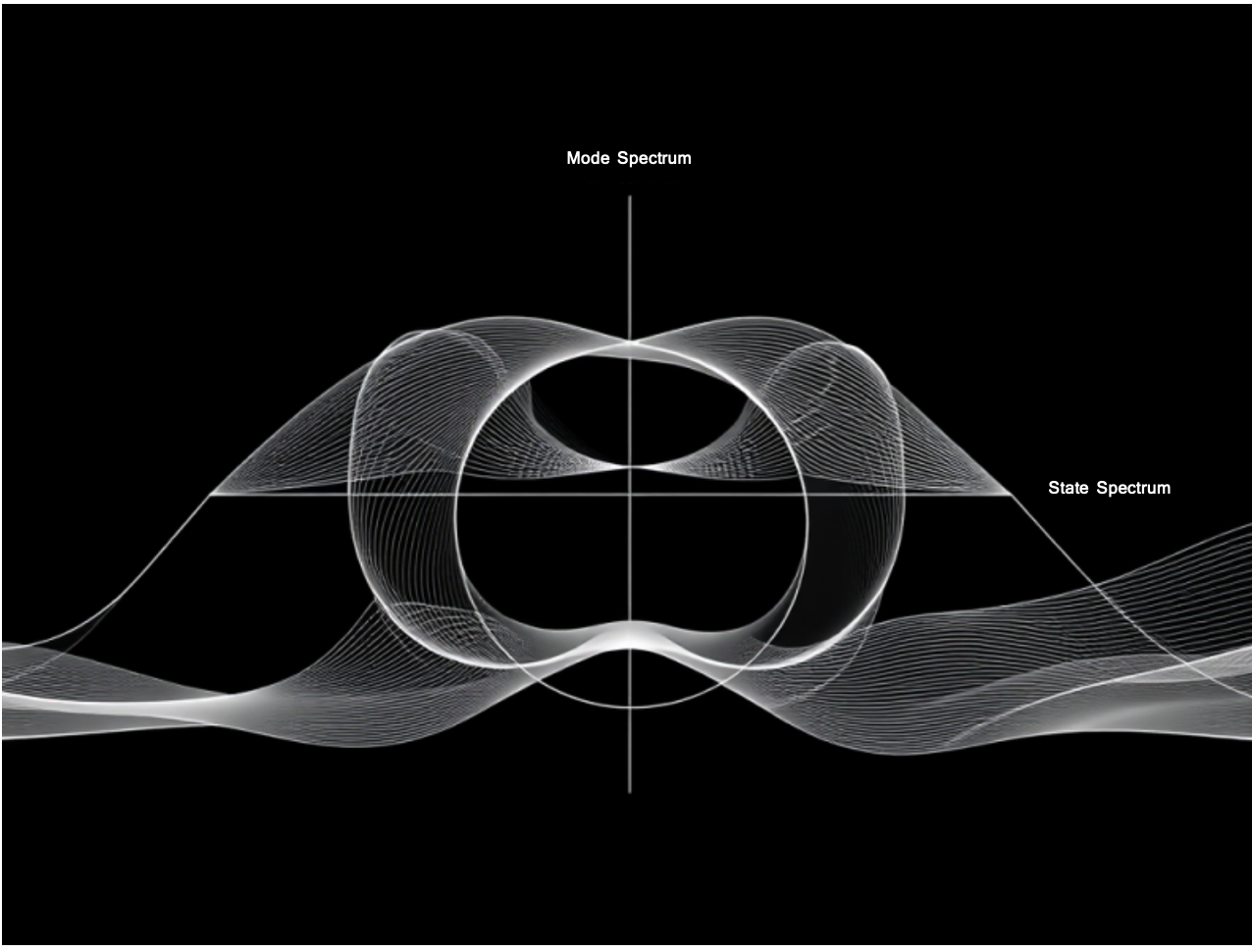
The intersection of semantic categories and sensory-motor areas suggests a unified mechanism for processing action, perception, and meaning. How we position ourselves in the world directly shapes our thinking and language. Designing a situated AI semantics model that can flexibly navigate complex, real-world contexts presents significant challenges. Such a model must not only process shifting lexical relations but also adapt to dynamic environments in real time, reflecting the ecological interplay of interaction, orientation, and meaning.
Approach:
Orientation Grammar: A semantic framework that focuses on dynamic, context-driven shifts and comparisons in meaning, emphasizing adaptability rather than fixed definitions.
Quadranyms: Hierarchical units that structure meaning across broad orientations (e.g., expansive vs. reductive) and evolvements (e.g., subjective vs. objective) for context-sensitive responses.
Key Concepts:
Intensions: Conceptual properties.
Extensions: Real-world instances.
Dimensions: Dynamic Orientations.
Application: Used for systems like Large Language Models to adjust orientation and generate contextually relevant, responsive outputs.
This is the Dynamic Quadranym Model (DQM):
It is about building a completely different kind of artificial intelligence—one that is grounded in a continuous, dynamic process of orientation to a world teeming with meaning, rather than one that simply computes a static representation of it.
The DQM provides a framework for guiding systems like large language models (LLMs) by aligning current states with potential futures across various layers. It uses an orientation grammar to ensure that outputs remain orientationally situated and responsive to real-time situations.
(Semantic Framework: Orientation Grammar and Word-Sensibility Theory)
In these posts, we will explore word-sensibility (Q) and its potential applications in artificial intelligence and natural language processing.
We welcome an open dialogue on a range of systemic perspectives, including enactvism, cybernetics, process philosophy, phenomenology, and many other topics related to AI, nature, and human experience.
We look forward to your insights and contributions!
Word-sensibility (Q), as presented, is a theoretical framework. While it offers insights into cognition, emotion, and dynamic systems, its application and assertions about the real world remain conceptual and speculative. The Q model is designed to simulate how meaning and semantic orientation might be structured in both human and AI systems, but it is not intended to reflect an empirical or deterministic representation of reality. Readers should approach the model as a conceptual tool for understanding complex interactions rather than a definitive explanation of real-world processes.
Introduction — From Stabilization to Persistence Topology The Dynamic Quadranym Model (DQM) initially appears similar to several familiar theoretical traditions. Its language of hysteresis, persistence, gating, and coherence naturally evokes comparisons to: cybernetics, dynamical systems theory, predictive processing, enactivism, and regulatory feedback architectures. At first … Continue reading Persistence Topology, Semantic Core, and Persistence Grammar in DQM
Many theories of cognition and artificial intelligence focus on representation. Others emphasize embodiment, enactivism, or interaction with the environment. Despite their differences, these approaches often share a common assumption: meaning is the primary object of analysis.
Large language models reconstruct local semantic plausibility exceptionally well. They generate contextual continuations through probabilistic semantic reconstruction. However, they do not appear to inhabit durable persistence topology beneath that reconstruction. As a result, local coherence may remain intact while global orientational continuity drifts.
Current artificial intelligence systems demonstrate extraordinary semantic competence while simultaneously exhibiting persistent failures in long-horizon coherence, autonomous continuity, contextual stability, and durable conceptual orientation. Contemporary architectures largely achieve coherence through repeated semantic reconstruction: relevance, salience, continuity, and behavioral appropriateness are continuously regenerated through probabilistic inference over symbolic representations.
This paper argues that these limitations emerge not from insufficient semantic scale, but from the absence of a distinct computational regime: persistent orientational coherence.
Interpretive Note The Dynamic Quadranym Model should not initially be read as a semantic taxonomy, symbolic decomposition, or representational architecture. Its primary concern is the continuity of orientation under changing situational conditions. Terms such as HQ, QU, closure, admissibility, variation, and hysteresis name operational relations … Continue reading Field, Event, and Orientational Grounding for AI Semantics
A common misread: This article is not an argument against contemporary AI systems, LLMs, or semantic architectures. In fact, the framework assumes their continued importance and effectiveness. The question being explored is narrower: whether semantic reconstruction alone is sufficient for long-duration coherence, persistence, and adaptive … Continue reading Beyond Semantic AI: The Missing Glue of Intelligence
Introduction — Orientation Before Representation Most systems of language, logic, and artificial intelligence begin from an assumption so familiar it often goes unnoticed: meaning is primary. Under this assumption, cognition is generally modeled through: semantic representation,symbolic manipulation,categorical organization,and propositional relations. Words are treated as carriers … Continue reading Quadranym Workflow Guidelines
This article serves as a high-level introduction to Orientation Grammar and the Dynamic Quadranym Model (DQM), outlining the framework’s central claim that coherence and orientation precede semantic representation. Across three sections, the article introduces the philosophical foundations of the model, explores why orientational persistence may … Continue reading Orientation Grammar: The Dynamic Quadranym Model
Artificial intelligence today exists in a strange and historically unprecedented condition. Modern systems possess extraordinary capacities for semantic synthesis, statistical prediction, symbolic manipulation, multimodal processing, retrieval augmentation, and increasingly sophisticated forms of reasoning. Large Language Models can summarize philosophy, write software, explain physics, imitate styles, … Continue reading Why Current AI Has Intelligence Components but Not Orientational Coherence
The Dynamic Quadranym Model (DQM) proposes something fundamentally different. It attempts to model not merely semantic content, but the orientational coherence that allows semantic content to stabilize at all.
This Dynamic Quadranym (DQM) This is less about “explaining a model” and more about exposing a condition Orientation, from the perspective of the Dynamic Quadranym Model (DQM), is not a property added to cognition after meaning is formed. It is the operational condition that allows … Continue reading Coherence Before Semantics Is What Holds Before Meaning
The Static Quadranym To understand the dynamic quadranym, we begin with the invariant structure that anchors it to orientational grammar. At its most general level, the quadranym is an invariant orientational construct. It is not yet a dynamic event, a field process, or a semantic … Continue reading The Quadranym: Its Static and Dynamic Forms
Lead-in: Why the Quadranym Is Great but Hard to See at First Before anything can mean, it has to hold together. Modern systems such as natural language models and transformer architectures already do this remarkably well within a given situation. Through autoregressive prediction and continuous … Continue reading The Quadranym: A Pre-Semantic Structure of Tension and Resolution
Toward a Process-Oriented Architecture of Situated Meaning 1. Introduction The Dynamic Quadranym Model (DQM) project addresses one of the central impasses in artificial intelligence research: the semantic wall—the point at which symbolic or statistical models can manipulate language but cannot inhabit its meaning. While current … Continue reading From Concrescence to Coherence: Whitehead through the Semantic Core (DQM)
This essay explores the origin of value through three distinct yet converging perspectives: Albert Camus, Alfred North Whitehead, and the Dynamic Quadranym Model (DQM). For Camus, value is claimed in revolt — coherence held by human will against an indifferent universe. For Whitehead, coherence is felt as fundamental to reality itself, intrinsic to each occasion of becoming and preserved in the advance of creativity, even in tragedy. The DQM reframes these insights procedurally, showing coherence as a default, recursive function that grounds both subjective dignity and objective meaning. Together, these perspectives reveal coherence as the generative ground of value — claimed, felt, and expressed.
Orientation precedes meaning. PD (novelty) presses; ND (coherence) holds. A gate condition—ND@S≥PD@O—governs when arcs admit potential, close, perish, and egress as superjective lineage. DQM instruments Whitehead’s creativity/concrescence/satisfaction/superject so we can diagnose, preserve, and reuse meaning as managed illumination.
The Unknowable Engine: Blind Spots as Foundational Features of Situated Cognition argues that intelligence does not rest on perfect knowledge but on structural limitations that guarantee perpetual motion. The Dynamic Quadranym Model (DQM) identifies two blind spots of orientation: the epistemological blind spot, rooted in the opacity of perception, and the procedural blind spot, rooted in the opacity of action. These blind spots are not errors but essential design features: they ensure that coherence is never final and that reorientation is always necessary. Distinguishing them from perturbations—situational disruptions that launch new arcs—the essay shows how blind spots are permanent constraints that make process thinking indispensable. Intelligence, in this view, is not the elimination of uncertainty but the art of navigating it, turning the opacity of being into an engine of change.
Orientation Beyond Language and Music: Introducing the DQM’s Semantic Core” explores how the Dynamic Quadranym Model (DQM) offers a groundbreaking framework for understanding meaning not as fixed content, but as emergent coherence shaped by embodied orientation across systems. Drawing from evolutionary musicology, cognitive science, and AI, the article traces how thinkers like Gary Tomlinson and Elan Barenholtz set the stage for the DQM’s central innovation: the Semantic Core—a procedural engine that tracks, relates, and resolves tensions across linguistic, perceptual, and motor systems. With detailed examples, including the “door” quadranym, and a Q&A that addresses the limitations of traditional models, this piece provides both a conceptual foundation and a practical lens for rethinking orientation, coherence, and intelligent behavior—human or artificial.