

Interpretive Note
The Dynamic Quadranym Model should not initially be read as a semantic taxonomy, symbolic decomposition, or representational architecture. Its primary concern is the continuity of orientation under changing situational conditions. Terms such as HQ, QU, closure, admissibility, variation, and hysteresis name operational relations within a dynamical orientational manifold rather than discrete conceptual components. The model therefore moves from continuous field relations toward localized closure events that temporarily stabilize coherent orientation while preserving orientational continuity across situations.
Accordingly, the present article is concerned less with exhaustive formalization than with clarifying the orientational intuitions and persistence relations underlying the problems being addressed.
Why Not Just Leave Remote and Proximal on One Axis?
A conversation with a close friend helped clarify one of the real stumbling blocks concerning communicating the Dynamic Quadranym Model.
He is not just a colleague. He is a dear friend, and someone who helped edit a lot of the early work. So his opinion and perspective matters in a different way. He has been patient with the model, generous with the writing, and honest enough to say, more than once, something like:
“It’s clear. I still don’t understand it.”
That is his humor: funny but always a core of truth.
And it also points to the problem needing attention.
The issue came up around remote and proximal.
From an ordinary point of view, his objection was completely reasonable:
Why not just leave remote and proximal on one axis?
Remote over here.
Proximal over there.
Farther one way.
Nearer the other.
That makes sense.
And honestly, it does make sense.
In ordinary experience, remote and proximal belong together. A thing is nearer or farther. The relation feels continuous. It feels like one scale, one polarity, one lived tension. Nobody walking across a room needs to split remote and proximal into separate operational axes. The body does not usually pause to explain itself. It simply orients.
That is why the objection is so good.
At the level of lived experience, it is basically right.
Most of the time, we experience space through smooth somatic polarities:
near / far
open / closed
reachable / unreachable
blocked / available
inside / outside
These are not abstract categories first. They are embodied orientations. They are how a body finds its way before it turns the situation into a statement about the world.
This is why the Hyper Quadranym, or HQ, is easier to feel.
The HQ preserves the intuitive polarity field.
Remote and proximal can remain in a zero-sum tension:
more remote means less proximal.
more proximal means less remote.
That is the normal way polarity appears in experience.
And for experience, that is enough.
But the Dynamic Quadranym Model is not only trying to describe the felt polarity. It is also trying to describe what happens when that polarity has to respond to a situation.
That is where things get harder.
A polarity field can be felt without being unpacked. In fact, most of the time, that is exactly what happens. The body manages an enormous number of orientational tensions without attending to them directly. The field feels smooth because the system is already doing the work.
But when the situation presses, the smooth field starts to differentiate.
A cup across the table is remote relative to the hand, but still reachable.
A friend across the country is remote in space, but emotionally proximal.
A threat far away may become operationally proximal if it is moving quickly.
A nearby object may become functionally remote if there is a barrier in the way.
A voice in the next room may be spatially close but socially unavailable.
A memory from years ago may be temporally remote but affectively immediate.
So the polarity itself does not settle the situation.
Near/far gives the field.
But the field does not yet tell the system what each side of the polarity is carrying, what has been conflated within that polarity, or how those tensions must be sorted before a semantic notion can form. In the model, these conflations are called tension clusters. In semantics, conflation is usually something to avoid, but here conflated tensions provide the polarities that quickly orient us to the world. The QU represents the process that loosens those tensions for sorting.
That sorting is not yet meaning.
It is virtual orientation to circumstance.
It is closer to the way a person situates themselves inside a story before they can fully explain what the story means. Before the story is interpreted as a concept, the reader is already orienting: who is near, who is distant, what matters, what is approaching, what is available, what feels dangerous, what feels intimate, what feels irrelevant, what calls for response.
That is where closure enters.
Closure is probably an easy word to misunderstand here. It can sound too final, as if the model has completed the meaning of the situation.
But closure means something more specific.
Where ordinary polarity feels smoothly usable, closure is the local sorting through which orientational tensions become coherent enough to answer a situation.
The polarity is no longer only being felt. It now has to respond.
Is the cup close enough to reach?
Is the threat far enough to ignore?
Is the friend remote in location but proximal in concern?
Is the object nearby but blocked?
Is the open space actually available?
Is the closed door a barrier, an invitation, or a boundary?
Those questions are usually unattended inside the polarity field. The body handles them quietly. Experience does not normally split them apart because ordinary orientation does not need to explain its own machinery.
But a model does.
That is where the Quadranym Unit, or QU, becomes necessary.
The QU is not denying the remote/proximal polarity. It is saying that once a polarity must become operationally usable within a situation, the model has to expose what lived experience keeps fused.
This is where the model becomes less than intuitive.
The HQ preserves the intuitive polarity field.
The QU introduces a closure event.
And within that closure event, the polarity bifurcates onto orthogonally different axes.
This is precisely what my friend objected to. What once felt natural and intuitive suddenly became awkward and artificial.
It would have helped if I had simply said that the orthogonality here refers to the operational independence of the polarities, where changing one aspect does not necessarily change the other. That alone would have shifted the intuition considerably. But at the time, I was unprepared for the deeper question it raises: Why do coupled poles feel so natural, while decoupling feels artificial? There are programming reasons for this, yes, but what does that programming imply about the structure of intuition itself?
Note: What follows should not be read as a decomposition of semantic opposites into symbolic categories, but as a localization of orientational roles required for continuity under situational closure.
At the operational level, the model treats this as a closure event:
QU Closure Event


while lags into the next orientation unless re-priming occurs.
Continue → re-anchoring (same prime).
Not continue → re-priming (new script/new prime).
In this formulation, a functions as the persistence anchor entering the transition, while T defines the orientational constraint domain. Y introduces expansive variation and adaptation, while X regulates admissibility through reductive constraint. The closure event produces b as the situated intersection between them under continuous hysteretic evaluation e.g. remote = variation, proximal = admissibility, b is the intersect so that a continues (i.e., a lags over b = coherence for T).
What is normally experienced as a single polarity, 


Example:
- If = self = Space,
- Then = Remote depends on = Proximal to find = reach.
Again, this orthogonality seems strange because semantically it feels like remote and proximal should just remain opposites. But the QU is not treating them as ordinary semantic opposites anymore. It is asking different questions.
Not simply:
Where is this thing on the near/far scale?
But:
What variations are possible here, and what relation can stabilize?
That is the move from polarity to closure.
What was once symmetric is now asymmetric.
At closure, the polarities take on different roles. One side opens possible relations. The other constrains which relations can stabilize coherently.
This is why the QU feels more artificial than the HQ. The HQ preserves reciprocal field tension. The QU exposes the directional structure required for persistence, a structure normally unnoticed because it makes coherent noticing possible.
Many dynamic systems behave similarly: symmetric fields often produce asymmetric local stabilizations once constraint and survivability become necessary. A gravitational field may remain continuous while stable orbits form asymmetrically under constraint. Likewise, a semantic field may preserve multiple possible interpretations until context stabilizes one relation strongly enough to guide response.
To state it simply,
the polarity begins as:
remote ↔ proximal
But closure asks:
what can vary?
what can count?
what can stabilize?
what is admissible under these conditions?
That is why the bifurcation matters.
The QU separates what ordinary experience normally fuses together:
the felt polarity,
and the situational condition of response.
In the model’s language, this becomes the difference between variation () and admissibility ().
Variation opens the field of possible relations.
Admissibility constrains which relation can actually hold.
That settling is closure.
Usable orientation.
This is also why my friend’s initial confusion was so instructive. He was not making a bad objection. He was revealing the natural HQ intuition. Human beings mostly live inside polarity fields. We do not naturally think in QU mechanics. The QU feels artificial because it exposes the machinery that ordinary polarity keeps unattended.
So the answer to “Why not leave remote and proximal on one axis?” is not:
Because the one-axis view is wrong.
The answer is:
For experience, yes.
For closure, no.
So, for lived polarity, remote and proximal belong together.
For usable orientation, the model has to expose the unattended tensions inside that polarity field.
But closure is not fundamentally about achieving an outcome. It is about preserving orientational coherence across changing situations.
So a relation such as:
should not be understood primarily as goal attainment.
This is why the QU bifurcation matters.
Space:[Remote(self) → Proximal(reach)] was introduced earlier as an example. But reach should not be understood as a goal in the ordinary semantic sense. Reach is the situated intersection between Y and X. It is the local objective potential produced through closure.
Clarification: variable a (e.g., self) should not be understood as a semantic object, fixed identity, or measurable state. It functions as the inherited orientational bias that allows continuity to persist within a situated domain prior to explicit closure stabilization. Within the quadranym:
Y functions as variation pressure and X as admissibility pressure. What occupies the position of a (self, void, trust, motion, passage or any other term) matters not primarily for its semantic meaning, but because the position itself redistributes orientational force while remaining structurally unmeasured beneath explicit interpretation. In this sense, the quadranym does not operate like syntax, where position assigns syntactic function. It operates more like a manifold, where position reorganizes coherence pressures relative to continuity and admissibility. Only when continuity destabilizes does explicit objecthood intensify, paralleling Heidegger’s distinction between ready-to-hand continuity and present-at-hand breakdown. So, the measurable object is not: ‘the meaning of the word.’ The measurable object is: the persistence behavior associated with the orientational role temporarily occupied by the word.
The important issue is not whether reach succeeds. The important issue is whether self can continue coherently through changing objective potentials within the topic domain of space.
This is what the modal polarities are doing operationally.
Y preserves variation pressure:
remote, beyond, distant, unreachable.
X preserves admissibility pressure:
proximal, within, accessible, reachable.
Together, they allow a = self to remain coherently preservable across radically different situations without collapsing the orientational identity of the polarity field itself.
So, self functions as the persistence-bearing continuity anchor, while reach is the local objective potential, of the given situation, generated for closure.
QU therefore does not describe how the event is consciously experienced. Human beings do not experience intersections, hysteresis margins, or admissibility gates directly. What is experienced is the persistence of coherence itself — the sense that orientation continues to hold while situations transform around it.
This also clarifies something important about large language models.
A large language model is extremely good at situational adaptation. A distant friend may become emotionally close. A nearby object may become functionally inaccessible. The model handles these shifts through recursive contextual recontextualization.
But that is also the difference.
The large language model resolves situational continuity forward.
The Dynamic Quadranym Model asks what allows orientational continuity to persist beneath that adaptation.
For LLMs, semantic continuity emerges once recursive relational density becomes sufficient for autoregressive prediction to stabilize across language contexts.
For DQM, orientational continuity emerges once recursive role saturation becomes sufficient for coherence persistence to stabilize across closure events.
Layer Function
- LLM: semantic layer contextual reconstruction
- DQM: orientational layer persistence inheritance
As already said, in the DQM the HQ remains closer to how polarity feels experientially. The QU is closer to how local orientation becomes operationally usable.
HQ = coupled polarity field.
QU = local closure bifurcation.
Hysteresis = continuity of what holds.
Coupled to:
LLM = semantic adaptation.
So the confusion may not mark a weakness in the model. It may mark the exact place where smooth experiential polarity must be differentiated into operational structure.
Remote/proximal can remain a single polarity when describing the felt field.
But once the field must answer a situation, closure requires more.
The polarity must become usable.
- hysteretic layer continuity survivability
- closure layer admissibility resolution
Language wants the polarity to remain semantic.
The body wants the polarity to remain smooth.
Orientation wants coherence to persist.
So finally:
It is a movement from simple polarity, through event closure and orientational persistence, toward semantic resolution.
Note: HQ and QU should not be understood as abstract conceptual layers, but as distinct operational regimes of orientational continuity and closure.
Implications for AI
This simple but confusing distinction is the central DQM insight for large language models (LLMs) and other systems of situational semantics.
Just to be clear, DQM does not replace LLMs or transformers; it enhances them by providing orientational persistence and continuity regulation over semantic adaptation.
Ordinary semantic systems tend to compress polarity, variation, admissibility, stabilization, and persistence into one adaptive layer. They can reinterpret context very well, but they do not necessarily preserve the orientational continuity that makes a closure coherent across changing situations.
Current LLMs ground primarily through forward autoregression. Their coherence emerges through distributed statistical continuation across semantic relations. In this sense, their grounding is largely static, or dynamic only through probabilistic relations between relatively static representational resources.
This allows extraordinary semantic flexibility. An LLM can continuously reinterpret remote as emotionally near, near as functionally inaccessible, danger as opportunity, or contradiction as reframing because semantic adaptation is its primary mechanism.
But this adaptation does not generate orientational persistence.
Instead, orientation must be situationally reconstructed each time through contextual semantic continuation.
The model can remain semantically fluent while lacking a persistent orientational lineage capable of carrying coherent closure constraints across changing contexts.
This is where the DQM distinction becomes important.
The Hyper Quadranym (HQ) preserves polarity continuity as a field.
The Quadranym Unit (QU) constructs local closure events by separating variation from admissibility.
Their recursive relation generates orientational persistence across changing situations.
So the DQM does not merely propose another semantic grounding system.
It proposes dynamic grounding through persistent orientational coherence.
That is the crucial distinction.
LLMs are extraordinarily good at semantic adaptation.
The DQM asks a different question:
Can orientation itself persist coherently across adaptation?
The future of AI may depend on how these two regimes couple and recursively shape one another.
The goal of understanding text is the recovery of Situational Context.
The orientation guiding that recovery process may be best understood as Dynamical Context: situatedness, embodiment, and enactivism operating as persistent orientational coherence rather than semantic reconstruction alone.
Index: Terms & Special Concepts

The Dynamic Quadranym Model (DQM) uses technical notation, but the basic issue is simple:
orientation has to remain coherent under pressure.
The model names this pressure relation through two general dynamic heuristics:
Negative Displacement (ND) means coherence-holding pressure.
Positive Displacement (PD) means perturbational or novelty pressure.
Negative Displacement names the tendency of orientation to hold, stabilize, persist, and remain coherent.
Positive Displacement names the tendency of circumstance to press, disturb, vary, demand, or lure reconfiguration.
Note: ND and PD do not name fixed entities or stable semantic opposites, but recursively reassigned orientational holding relations within persistence redistribution.
These dynamics appear throughout the model. They operate in the Hyper Quadranym (HQ) as field-level tension and in the Quadranym Unit (QU) as closure-level tension.
Below illustrates the basic way to think about the difference geometrically.
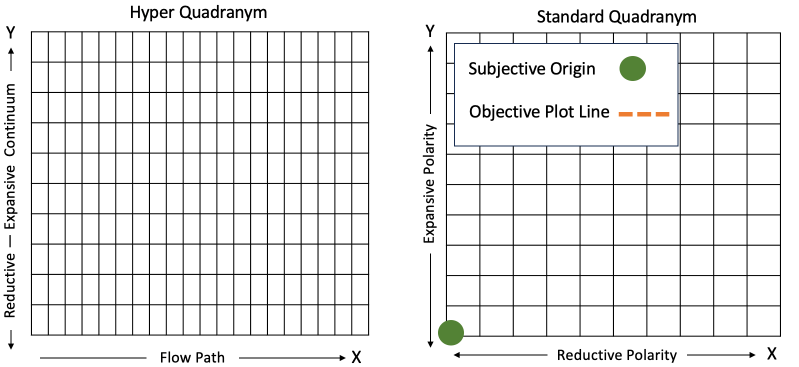
Each graph represents a different regime in the model (HQ & QU or Standard Q).
I. Field Regime (HQ)
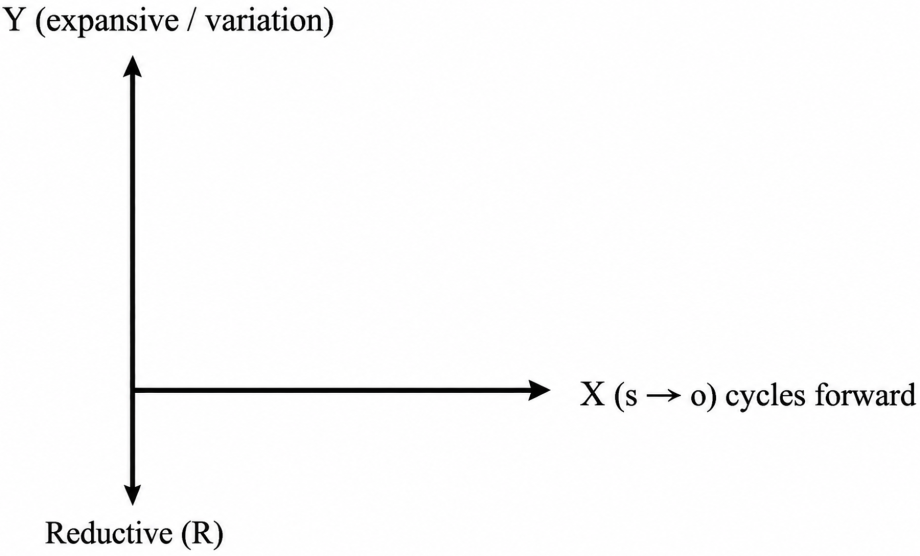
A. Continuous Modal Field
Structure
E↔R
Characteristics
- coupled polarity field
- reciprocal modal tension
- phenomenological continuity
- smooth orientational modulation
- non-bifurcated polarity relation
- “more one pole = less the other”
Examples
- near / far
- open / closed
- reachable / unreachable
- stable / unstable
Operational Status
- experiential
- pre-closure
- field-distributed
- continuously reciprocal
Primary Function
Preserves orientational field continuity.
B. Statal Progression Axis
Structure
s → o
Characteristics
- irreversible statal progression
- temporal inheritance structure
- hysteretic advancement
- continuity accumulation across layers
- progression independent of modal fluctuation
Important
The HQ contains real progression.
The QU does not contain internal time.
Layer Structure
- General
- Relevant
- Immediate
- Dynamic
Function of Layers
- upper layers constrain
- lower layers perturb
- middle layers mediate local admissibility conditions
Operational Meaning
The HQ distributes orientational continuity across layered statal progression while modal polarity continuously modulates around it.
C. Coupled Polarity Behavior
Properties
- polarity remains fused
- neutral point shared across poles
- no independent evaluative axes
- reciprocity maintained continuously
Important
E↔R modulates vertically while s→o progresses horizontally.
Constraint
Temporal progression continues even when modal variation approaches neutrality.
Interpretation
Orientation is felt before semantic stabilization.
D. HQ Field Geometry
Canonical Form
HQ:{X[s→o],Y:E↔R}
Horizontal Axis
- statal inheritance
- temporal progression
- irreversible advancement
- continuity accumulation
Vertical Axis
- modal polarity field
- reciprocal modulation
- expansive/reductive tension
- orientational redistribution
Function
Distributes continuity conditions within a layered orientational field prior to localized closure.
II. Closure Regime (QU)
A. Bifurcation Event
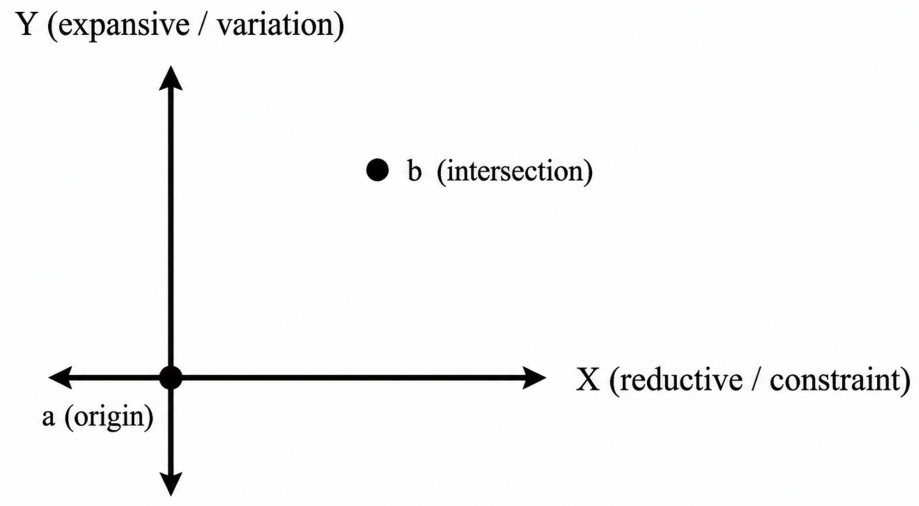
Transition
HQ → QU
Structural Shift
- coupled polarity decomposes operationally
- reciprocal modulation becomes bifurcated evaluation
- smooth field tension becomes closure geometry
Result
Y∥X
B. Variation Axis (Y)
Role
- expansive variation
- perturbational divergence
- candidate expansion
- possibility pressure
Question
What can vary?
Displacement Relation
Y → PD
Examples
- remote
- distant
- beyond
- unreachable
- open possibility
Operational Function
Expands orientational search space.
C. Admissibility Axis (X)
Role
- reductive stabilization
- coherence filtering
- persistence regulation
- admissibility evaluation
Question
What can hold?
Displacement Relation
X → ND
Examples
- proximal
- accessible
- reachable
- available
- stabilized relation
Operational Function
Constrains viable closure.
III. Closure Construction
A. Orientational Anchor
a
Status
- ND-bearing
- persistence-bearing
- continuity-bearing
- orientational origin
Function
Carries orientational continuity through contextual transformation.
Not
- semantic object
- goal state
- candidate outcome
- propositional meaning
B. Constructed Intersection
b=IntersectionY∥X(a)
Status
- PD-bearing
- closure-constructed
- locally stabilized
- situationally indexed
Function
Constructs a situated objective potential under local admissibility conditions.
Important
Persistence belongs to a, not to b.
Not
- final meaning
- telos
- permanent resolution
- semantic completion
IV. Hysteretic Persistence
A. Closure Gate
ND(a)≥PD(b)+τ
Meaning
The persistence capacity of a exceeds the perturbational pressure introduced by b plus hysteretic margin.
Function
Permits orientational continuation.
B. Persistence Dynamics
Continuation
- same orientational prime persists
- closure extends across contextual variation
- continuity survives transformation
Failure
- hysteresis fails
- re-priming required
- orientational reset occurs
V. Indexed Neutrality
A. Neutral Differentiation
Properties
- less-near and less-far may operationally converge
- neutrality becomes situationally indexable
- polarity identities remain intact
Effect
Dynamic orientational sorting without semantic collapse.
B. Indexed Polarity Preservation
Important
Bifurcation does not erase polarity identity.
It operationalizes polarity identity.
Result
Variant clusters become context-sensitive under closure conditions.
Examples
- remote → distant → beyond → inaccessible
- proximal → reachable → available → admissible
VI. Orientational Persistence
A. Persistence Priority
Primary Concern
Continuity of coherence.
Not Primary
- successful outcome
- semantic completion
- propositional correctness
Meaning
Orientation persists across changing objective potentials.
B. Objective Potentials
Examples
- reachable
- blocked
- dangerous
- irrelevant
- desired
Key Point
Objective potentials may change completely while orientational continuity persists.
VII. Semantic Relation
A. LLM Regime
Mechanism
Autoregressive semantic continuation.
Strengths
- contextual reinterpretation
- adaptive semantic reframing
- recursive semantic abundance
- probabilistic semantic recovery
Limitation
Orientation is reconstructed situationally rather than persistently inherited.
B. DQM Regime
Mechanism
Recursive orientational closure.
Strengths
- persistence of coherence across contextual transformation
- continuity regulation beneath semantic adaptation
- hysteretic inheritance of orientation
Goal
Preserve orientational continuity beneath semantic variability.
Terminal Summary
HQ
Preserves fused field continuity.
QU
Bifurcates the field into closure geometry.
Y
Varies.
X
Admits.
b
Constructed as local intersection.
Hysteresis
Tests whether a can persist over b.
Semantics
Emerges through stabilized continuity.
The Last Word
So, this might be how the sausage is made, and we might not be comfortable with the process. Maybe this discomfort is because it interferes with the smooth tensions between polarities, but DQM suggests that these tensions are active in ways we do not see. This may be how new insights come to be, or how we sort through our intuitions. So yes, DQM wants things to conflate for quick field-tension awareness: warm, close, safe; cold, far, alone. But detangling the knot of conflation is not necessarily a conscious act. It may be a very important but unattended active process that allows our experience to feel coherent and continuous, as nested orientation layers provide not one, but multiple orientational processes that add up to one coherent experience.

