

The Static Quadranym
To understand the dynamic quadranym, we begin with the invariant structure that anchors it to orientational grammar.
At its most general level, the quadranym is an invariant orientational construct. It is not yet a dynamic event, a field process, or a semantic interpretation. It is a stable formal arrangement of orientational roles that can be rendered canonically as:
Topic:[Expansive(subjective) → Reductive(objective)]
This is the Prime Quadranym.
For shorthand, these roles may also be referred to collectively as EROS:
- Expansive
- Reductive
- subjective
- objective
Here are related canonical forms that deepen the prime roles:
- Actual–Potential: [Potential(actual) → Actual(potential)]
- Active–Passive: [Active(active) → Passive(passive)]
- Being–Becoming: [Positive(being) → Negative(becoming)]
- Whole–Separate: [Singularity(whole) → Multiplicity(separate)]
The Prime Quadranym functions as a general orientational form. In this invariant state, it behaves more like an analytical framework than a dynamic process. In this respect, it can be compared loosely to organizational tools such as SWOT analysis: a stable structural arrangement used to organize relations and perspectives.
But unlike static analytical matrices, the quadranym also possesses a dynamic dimension.
That dynamic dimension only becomes visible once the orientational roles are separated into:
- Modes
- States
The distinction is essential.
Modes remain dynamically operative:
- Expansive
- Reductive
States remain orientationally anchored:
- subjective
- objective
This separation allows the invariant structure to become dynamic without losing coherence.
The same orientational roles may then appear through multiple canonical renderings.
For example:
| Topic | Expansive | Reductive | objective | subjective |
|---|---|---|---|---|
| Space | infinite | finite | between | void |
| Time | future | past | event | present |
| Agent | positive | negative | goal | self |
| Distance | far | near | relation | position |
| Direction | there | here | to | from |
| Door | open | close | barrier | passage |
| Container | out | in | full | empty |
| Energy | active | passive | matter | motion |
These renderings are not arbitrary metaphors or semantic substitutions. They are orientational variants preserving the same underlying formal roles.
This is why the quadranym can remain structurally invariant while appearing across many domains simultaneously.
In the next section, we show how these invariants structure perturbations into dynamic orientation. Quadranyms operate through the formulation below to produce local closure so that coherence ultimately survives across quadranym layers.
This formulation compresses the QU structure into an operational dependency rule:
If s for_T, then E depends on R to find o.
Using the terminology established in the document:
- s = subjective anchor
- o = objective stabilization
- E = expansive mode (variation, openness, possibility)
- R = reductive mode (constraint, limitation, selection)
- T = situational orientation/context
The statement expresses that objective coherence cannot emerge from expansiveness alone.
Within a given orientational condition T:
- the subjective anchor s initiates orientation,
- E generates variation or directional possibility,
- but E alone cannot stabilize coherence,
- therefore E must depend on R,
- because reductive constraint enables a locally determinate closure o.
The Dynamic Quadranym
This section will show how the invariant grammar structure becomes dynamic through two inseparable but distinct structures:
the Hyper Quadranym (HQ)
the quadranym unit (QU)
Both preserve the same orientational roles (EROS).
But they operate at different scales and in different modes.
HQ distributes ideal tensions across a continuous field.
QU expresses local stabilization within that field.
The same structure persists through both.
But neither operates in isolation.
The orientational field is continuously pressured by changing situational conditions. Within the model, these changing conditions are referred to as the situational context.
The situational context does not determine coherence directly.
It perturbs it.
The dynamical context withstands this pressure first through ideal tension distributions within HQ, and then through local event stabilization within QU.
Orientation therefore persists not in the absence of change, but through continuous exposure to it.
Under this exposure, orientation does not simply abandon one state and replace it with another. The subjective condition (a) must remain coherent enough through changing circumstances for an objective stabilization (b) to emerge from it.
The movement is therefore not a collapse of orientation, but a temporary resolution within it.
Within the model, quadranym units do not produce b as a statistical next-token prediction. They produce b as a satisfied objective potential (SOP): a temporary coherence closure formed under orientational pressure.
The point b therefore does not emerge simply because a likely continuation is selected within the truth-conditional space of the situational context. It emerges because dynamic orientational tensions locally stabilize coherence under changing situational conditions.
This distinction becomes necessary the moment the point b is misunderstood.
At first glance, the QU diagram appears simple enough: axes, tensions, and a point where they intersect. The eye naturally interprets this geometrically. It looks like a coordinate system, a semantic relation, or a resolved position between opposites.
But this reading collapses the structure too quickly.
The point b is not merely where lines cross.
It is where coherence temporarily holds under dynamically shifting tension.
That distinction changes the entire architecture.
At the global level, HQ preserves the field of ideal tensions.
Its prime orientational roles can be rendered canonically as:
![HQ:{X:[s \rightarrow o],,Y:E \leftrightarrow R}](https://s0.wp.com/latex.php?latex=HQ%3A%7BX%3A%5Bs+%5Crightarrow+o%5D%2C%2CY%3AE+%5Cleftrightarrow+R%7D&bg=f5f5f4&fg=3c362e&s=0&c=20201002)
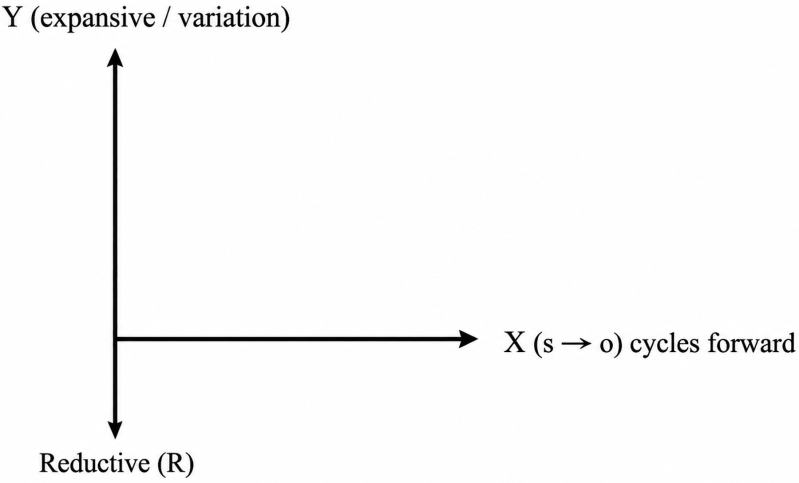
(HQ Graph)
This is not a semantic structure.
It does not describe meanings, objects, or categories.
It distributes orientational conditions.
Within HQ, polarity remains structurally coupled:
more expansive implies less reductive
more reductive implies less expansive
This is a zero-sum condition at the level of the ideal field itself.
But the field does not produce events.
It only distributes conditions under which events may locally stabilize.
Between the poles there are no fixed assignments.
Only continuously varying intensities.
The field does not ask:
What does this mean?
It asks:
What conditions are being distributed?
At the local level, QU operates differently.
The quadranym unit may be rendered as:
![T:[Y(a) \rightarrow X(b)]](https://s0.wp.com/latex.php?latex=T%3A%5BY%28a%29+%5Crightarrow+X%28b%29%5D&bg=f5f5f4&fg=3c362e&s=0&c=20201002)
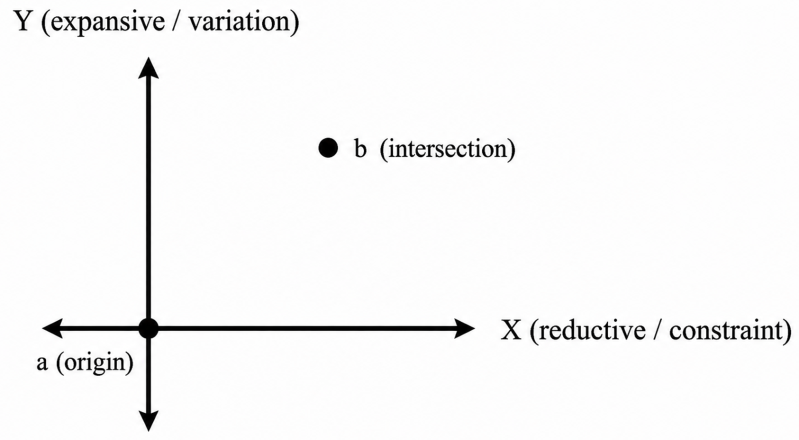
(QU Graph)
This is not a semantic proposition.
It is a structure of local orientational stabilization.
Operationally, it can be read:
If a for T, then Y depends on X to find b.
But this should not be interpreted causally or semantically too quickly.
a functions as an orientational anchor.
Y and X express dynamic tensions through which variation and constraint occur.
b marks a temporary coherence closure under pressure.
But this closure is never final.
Once stabilization occurs, the realized orientation itself becomes the basis for further variation, further constraint, and further acts of holding.
Orientation continuously reconstitutes itself through successive local stabilizations.
This is where the distinction between HQ and QU becomes critical.
Within HQ, the poles remain ideally opposed.
Within QU, local realization becomes dynamically indexed.
This means the ideal tensions remain invariant even while their realized intensities shift independently.
The infant example makes this easier to see:
![\mathrm{Baby}:[\mathrm{Cold}(\mathrm{feeling}) \rightarrow \mathrm{Warm}(\mathrm{comfort})]](https://s0.wp.com/latex.php?latex=%5Cmathrm%7BBaby%7D%3A%5B%5Cmathrm%7BCold%7D%28%5Cmathrm%7Bfeeling%7D%29+%5Crightarrow+%5Cmathrm%7BWarm%7D%28%5Cmathrm%7Bcomfort%7D%29%5D&bg=f5f5f4&fg=3c362e&s=0&c=20201002)
If interpreted semantically, the structure appears straightforward:
the infant feels cold and seeks warmth.
But semantic interpretation misses the operation entirely.
“Cold” and “Warm” are not functioning primarily as meanings.
They are functioning as invariant orientational tensions.
Their local realization can shift continuously without collapsing the structure itself.
An infant may become less cold while still remaining indexed toward the cold pole.
Warmth may diminish while still remaining structurally indexed toward warmth.
The poles remain ideal even while local realization changes dynamically.
This is why the structure holds.
Meaning alone cannot explain this persistence because meanings tend to stabilize through categorical identity:
cold is cold
warm is warm
comfort means comfort
But orientational coherence persists even when realization drifts across semantic boundaries.
Something may become warmer while still remaining indexed toward coldness.
Something may cool substantially while still remaining indexed toward warmth.
The orientational poles therefore behave less like categories and more like attractors within a tension field.
This is why the point b cannot be reduced to equilibrium.
Equilibrium implies cancellation, balance, or termination of tension.
But the QU structure does not eliminate tension at stabilization.
The ideal tensions remain active even as local coherence temporarily forms around them.
The event therefore preserves polarity rather than resolving it away.
And this is the essential distinction between HQ and QU.
Within HQ:
polarity remains ideally coupled,
tensions remain structurally invariant,
and conditions distribute continuously across the field.
Within QU:
realizations index dynamically,
stabilization occurs locally,
and coherence temporarily resolves as an event.
The same orientational roles persist through both structures.
But they are used differently.
The field distributes conditions.
The event locally stabilizes them.
And the point b marks the moment where coherence becomes locally determinate without ceasing to remain dynamic.
Meaning is not absent from this process.
Meaning is everywhere.
But orientation is somewhere.
The field contains more potential significance than any single event can stabilize at once. Orientation does not create meaning from nothing. It locally organizes coherence within an already meaningful field.
This is why the poles remain ideal while realization changes.
Why closure never becomes final.
Why orientation continuously reconstitutes itself through successive acts of local holding.
And this is why b is not merely an intersection.
It is the temporary holding of coherence under pressure.
NOTES: (MACHINE READABLE GRAPHS)
HQ:
↑ Y Expansive (E)
|
|
|
| • – • – • – • (progression cycle)
|
|———————-→ X (s → o) Cycles Forward
↓Y Reductive (R)
QU:
Y (expansive / variation)
↑
|
|
|
| • b (intersection)
|
↓
+ a (origin+) ←──────────→ X (reductive / constraint)
Dynamic Process:
anchor a
↓
intersection appears
↓
b forms as satisfied objective potential (SOP)
↓
a coherently lags over b
↓
hysteresis evaluation
↓
[a → b] becomes {a → b}’
↓
HQ registers progression cycle
The two aims of the article.
The philosophical layer establishes:
- what orientation is,
- why meaning alone is insufficient,
- why coherence must persist dynamically,
- why polarity cannot be reduced to static categories,
- and why stabilization is not equilibrium.
That layer is trying to redefine the ontology of coherence itself.
The operational layer attempts to show:
- how those orientational structures behave dynamically,
- how local stabilization occurs,
- how recursive persistence works,
- how field conditions distribute tension,
- and how coherent events emerge under pressure.
Central Goal: Illustrate the basic construct of orientation grammar, the quadranym.

