

Reference Frames for Artificial Intelligence
To understand is to experience harmony between what we aim at and what is given, between the intention and the performance – and the body is our anchorage in the world. ― Maurice Merleau-Ponty
Home Page Introduction:
A Systemic Approach to Word-Level Concepts
Site Summary: Machines can’t acquire commonsense naturally as humans do. To assist the machine acquisition of commonsense concepts, the idea is to analyze the words of a text utilizing reference frames. We call it Word-Sensibility. The goal is a text analysis to assess word sense by simulating human responsiveness. That is, the ability to act quickly and positively to situations in the world. Reference frames move quickly between general and relevant viewpoints. In this way, machines learn strategies to virtually orient to the things that people typically know. A conceptual model and propositions are proposed that could form the basis for further research.
The Quadranym Model of Word-Sensibility (Q): An Ecological Psychology perspective on Word-Level Concepts alongside Situated Cognition — Non-Mental-Representation — Enactivism — Cybernetics — Process Philosophy
Q: Pre-semantic relationships represented in units, scripts & layers.
Agents, World & Words
Context isn’t just the surrounding circumstances, because it includes and interacts with the subject that is surrounded, and the agent that tries to comprehend it all. ― Andrew Hinton 🔗
A Systemic Model for Contextual Orientation:
Unpacking words with word-sensibility analysis begins with the distinction between two types of context: Dynamical Context and Situational Context.
The goal for understanding text is to recover the Situational Context.
- Situational Context: the communicative ability to present or understand the objective circumstances in which an event occurs and will sometimes include the appropriate behaviors associated with it (i.e., an adaptive capacity).
We call the orientation to the recovery process a Dynamical Context.
- Dynamical Context: a situation resonates with a preexisting psychology, a predetermined expectation for behavior within that situation, and produces a synergy response, reshaped for the moment (i.e., a definitive point).
Actual Dynamic Sense aims to closely match with Situational Potentials:
Home Page Article: Model Overview
Lead-In: Orientation is an Action
Sensorimotor empathy is implicit, sometimes unintentional, skilful perceptual and motor coordination with objects and other people. I argue that sensorimotor empathy is the foundation of social coordination, and the key to understanding our conscious experience.
― Anthony Chemero 🔗
Agents orient to each other to communicate i.e., interpersonal orientation.
- The aim is a model that features personal and interpersonal orientation.
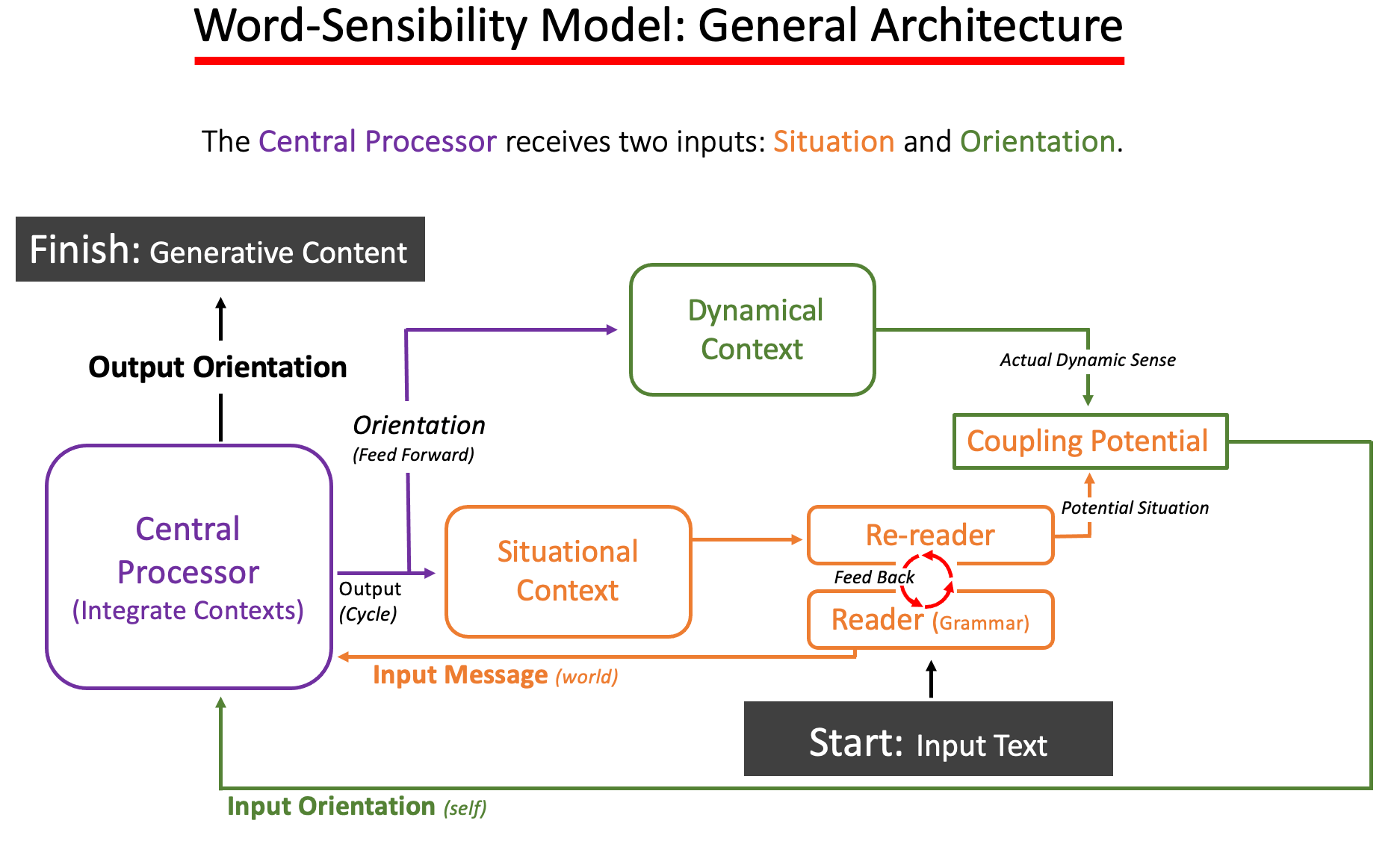
Implied is a mechanism common to action, perception and semantics.
- It’s about a self-model responsive to the consequences of its orientations.
Here, orientation is essentially expectations changing to match inputs.
The model (Q) differentiates between actual states (definitive aspects) and potential states (capacities for change). These are used to understand how agents engage with their environments and recall or imagine experiences.
(Note: The analogy is of a nervous system: the orange line acts as the afferent tract the purple line as the efferent tract the green line as the reafferent tract.)
Model Overview
If we use our brain systems for perception and action to understand, then the processes of meaning are dynamic and constructive. It’s not about activating the right symbol; it’s about dynamically constructing the right mental experience of the scene. ― Benjamin K. Bergen

- Introduction
- The Q Model
- Summing-up
1. Introduction
Word-Sensibility is About Agents Orienting to Communications: In this overview we will introduce, reference frames, nested layers, scripts and quadranym units. The goal is to model the responsiveness of social agents.
- The aim is to improve commonsense prediction with units of orientation.
- It’s about systems that generate artificial interpersonal orientation (AIO).
Word-Sensibility (Q) is a theoretical approach that can be interpreted for a wide span of applications: from API services for NLP to metaphor-analysis.
- Key concepts of the approach are multi-layered contexts and situatedness.
The theoretical ideas are most concerned with the non-linguistic aspects of using language; aspects that ground the responsiveness of communication.
- The aim of this page is to provide intuition for the model’s basic components.
Components and analysis are introduced using a simple sentence example:
- “Let’s move the couch over there.”
Units of orientation repurpose metaphorically for different situations.
- The word-sensibility model is more about a comparator than a computer.
(Note: The overlap between various semantic categories with sensory motor areas suggests that a common mechanism is used by neurons to process action, perception and semantics. Body & environment play important roles in thinking.)
2. The Q Model
Points of Discussion
We categorize as we do because we have the brains and bodies we have and because we interact in the world as we do. ―
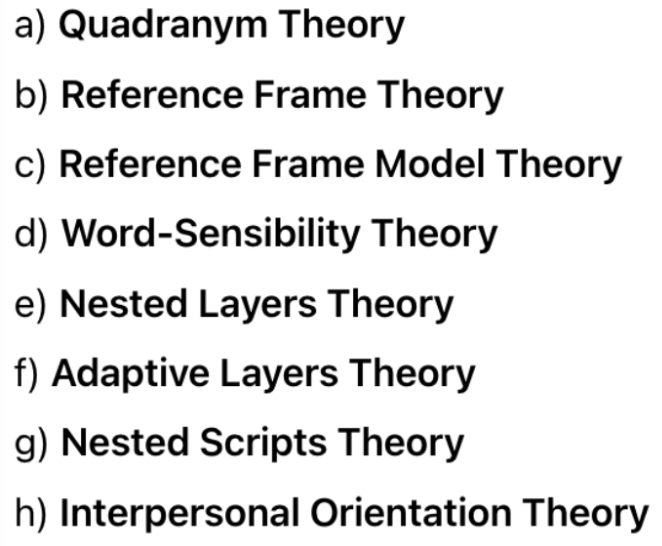
a) Quadranym Theory:
Normative Responses for Artificial Intelligence:
• The quadranym is a small unit of context in the Q system. It represents a response in the agent prompted to take aim at circumstance with potentials.
Quadranym Examples:
Quadranyms form orientation systems. Multiple systems can be active.

Orientational Response: signifier ➝ potentials ➝ signified ➝ actuals
Personal Orientation

Interpersonal Orientation

Constraint and Possibility for Active Orientation
(Note: Interpersonal orientation is about symbolic culture and the dynamic sense of the individual. It’s about meaningful events; not about mental representation.)
The meaning or value of a thing consists of what it affords.
― James J. Gibson
b) Reference Frame Theory:
Word-Sensibility (Q) is proposed as a model for text analysis. Data training involves a database with its features tagged to identify apt reference frames.
- A situation sets off expectations in a series of frames changing over time.
Reference frames derive from quadranyms (see examples). The quadranym examples apply to the reference frames used to anchor the situation below:
Situational Context Example:

Consider the sentence: Let’s move the couch over there.
General reference frames aptly apply, such as: agent, energy, time and space.
The words of the sentence are matched to reference frames:
- Agent(let’s), Energy(move), Time(the_couch), Space(over_there).
A reference frame (RF) targets word associations by way of latent topics:
-
RF: Agent(let’s) ………….Latent General Topic:[<find> goal of agent]
-
RF: Energy(move) ………Latent General Topic:[<find> matter of energy]
-
RF: Time(the_couch) …..Latent General Topic:[<find> event of time]
-
RF: Space(over_there)…Latent General Topic:[<find> between of space]
- RFs are viewpoints representing personal and interpersonal orientations.
(Note: Reference frames are general semantic orientations to topic fields. They assist semantic perspectives by providing virtual orientation for the given text.)
There are two types of word associations:
- Sentential associations are called text variants (e.g., word vectors).
- Reference frame associations are called latent variants.
Text variants are mapped to latent variants found in quadranyms.
- A quadranym has four facets; each with a number of latent variants.
Quadranyms provide templates. The RF Q template is as follows:
- Reference Frame Facets: Source, Target, Y , X
(Note: Latent variants color key: Condition States: source–target; Modes: Y–X. These terms represent the four dimensions of the quadranym. See Orientation.)
Text is parsed to source–target of RFs. Each represent a condition or state.
- RF Condition Statement: source ➝ target
(Note: The condition statement relates to latent variants given the relevant topic. Basically the question is how do the text topic variants make the statement true.)
A reference frame aims to match the text variants to it’s latent variants.
- E.g., General/Latent If agents Then goal ➝ Relevant/Text If let’s Then move
Source and target conditions are virtual mental states. Situations occur in the world. A source relies on a target to find what’s relevant in a situation.
- Source is the general condition state.
- Target is the relevant condition state.
RFs are like self replicating patterns that nest in hierarchical orders.
- Each reference frame is a latent general topic.
- The sentence is the relevant situation or topic.
Source and target state conditions aim to represent personal orientation.
- The source often represents an unattended and general resource response.
- The target always represents the attended and relevant resource response.
(Note: Source–target conditions are related or relative to source-target domains. Conditions are more about evolving while domains are more about comparing.)
Consider this Spatial RF:
- Space: void➝ between
In this reference frame system, the source void targets between to find the spatial measures offered: objects, regions, solid separation, spatial separation.
- Void is a factor that is a constant in relation to any variant of between. Void is in essence the background in a figure-ground relationship with between.
The text variants below agree with latent space variants void ➝ between:
- Space: move ➝ over_there
(Note: The potentialY–actualX differential is the Target e.g., clear Y and path X. Path refers to the given course or direction offered. Clear refers to accessibility.)
Spatial thinking is fundamental. Space shapes our thoughts and therefore we come into thoughts of space according to what’s relevant in our lives.
Space relates to the relevant topic under the enabling constraints of Agent.
- The agent’s move potential is the target state over_there of Space.
Text variants move➝ over_there nest under latent variants void➝ between.
(Note: The text statement is true for the RF because, for move of Space, clear is dependent on path to find over_there. Potential clear is the effected Y variable.)
Consider this Agent RF:
- Agent: self ➝ goal
(Note: For the sentence, Agent is the primary constraint over the other generals.)
A reference frame begins as a predicate for a word or text variant.
- e.g., let’s becomes a subject (state) predicated on agent: Agent(let’s)
let’s spoken by an agent refers to itself and one or more others as a group.
- Agent: self ➝ other(s)
All agents of the group have general source and target conditions.
- Agents: self ➝ goal
let’s becomes the source condition of Agent. move is its target condition.
- Agent: let’s ➝ move
(Note: let’s: contraction let us; first person plural imperative; allow; we; argument; subject. move: the base verb of the sentence and the predicate of the argument.)
The aim is to initiate interpersonal orientation.
- Agents: interpersonal orientation ➝ find goal
(Note: The general orientation is to synchronize agents to find goal. The relevant orientation is toward understanding what the situation entails ― what actions.)
Consider the relationships between the verb (move) and the latent targets:
- move relatedTo Agent(let’s) is offered goal
- move relatedTo Energy(move) is offered matter
- move relatedTo Time(the_couch) is offered event
- move relatedTo Space(over_there) is offered between
- move has potential relation to the targets and any related latent variants.
(Note: Targets are basic expectations inferencing models for a goodness of fit.)
Because move is the predicate of the sentence and the subject of the energy RF, energy is determined most relevant RF of the orientation:
- Relevant to the Sentence: Move(we, the_couch)
- Relevant to the Orientation: Energy(move)
In the model, there are two separate contexts to think about or consider:
- Situational Context (Objective circumstance including possible changes.)
- Dynamical Context (Predetermined expectation and apt responsiveness.)
- Dynamic context describes a situation in flux (e.g., environmental changes).
- Dynamical context implies homeostasis (i.e., aperiodic dynamical systems).
(Note: The term Dynamical Context is used to describe the orientation process. Situational (dynamic) and dynamical (responsive) refer to two distinct systems.)
The task is to integrate the two context variants into one system.
Next: A quick review review of the analysis just discussed in five steps.
1) System Report:
- Text Constituents: {<let’s, move, the_couch, over_there>}
- The Relevant Text Topic: Move(we, the_couch)
- The General Unit Topic: Agent:[Y(self) ➝ X(goal)]
- The Relevant Unit Topic: Energy:[Y(motion) ➝ X(matter)]
- Hierarchical Range: Layers = From Agent To Energy
(Note: Anchoring is the integration between the general and the relevant.)
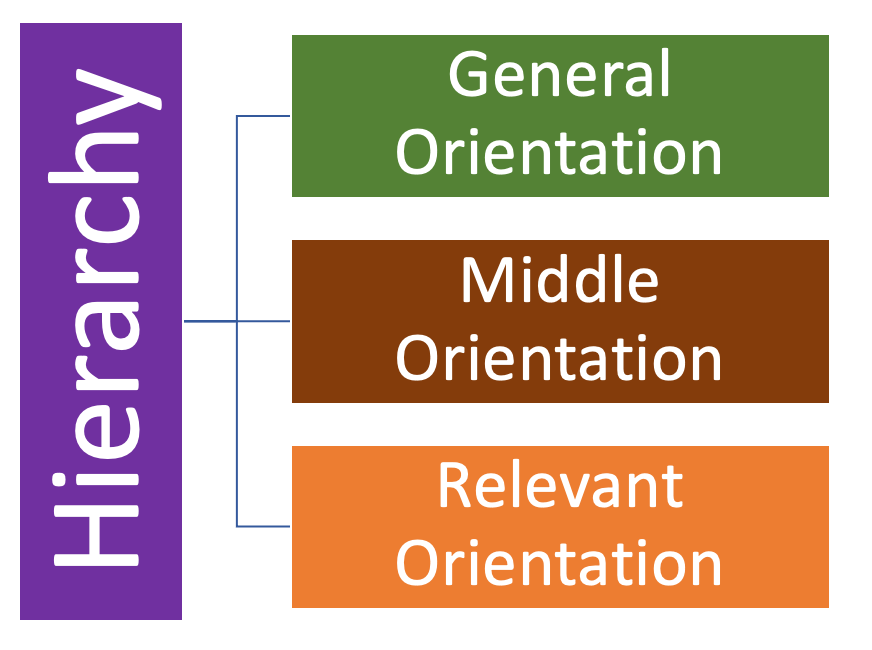
2) Nested Hierarchical Script: [agent > time]>[time > space]>[space > energy]:
-
General………………..Agent(let’s)
-
Middle General……. Time(the_couch)
-
Middle Relevant……Space(over_there)
- Relevant……………….Energy(move)
- The hierarchy initially followed the syntactic order of the sentence.
- Relevant is a moment in time that the general conditions overarch.
- Generals are the constraining events enabling the relevant context.
(Note: Energy is relevant to space, and space to time, and all is relevant to agent. Energy is most relevant because as shown next it targets the matter (i.e., couch).)
3) Find apt source–target latent variants to best cluster text topic variants.
- IF Agent THEN self targets goal to <find> text topic associations.
- IF Time THEN present targets event to <find> text topic associations.
- IF Space THEN void targets between to <find> text topic associations.
- IF Energy THEN motion targets matter to <find> text topic associations.
(Note: Reference frames are populated by quadranyms. The system pulls context around the latent variants relating to the four dimensions of the quadranym: two modes and two states. Above is only presenting the state dimensions. Modes act as predicates and x-y variables for RF models. RF models will be discussed later.)
4) Grammar links assist in parsing the text to source and target conditions:
- Agent: From imperative verb To infinitive verb: let’s ➝ move
- Time: From direct object To transitive verb: the_couch ➝ move
- Space: From verb To prepositional phrase: move ➝ over_there
- Energy: From transitive verb To direct object: move ➝ the_couch
- Grammar links & source-target relations assist future parsings.
(Note: Quadranym training assists parsing source or target verb per layer.)
5) Tune RF network relations between base verb & RFs
- move isA goal = target of Agent
- move isA event = target of Time
- move implies void = source of Space
- move isA motion = source of Energy
(Note: Notice that space relation can also use hasPrerequisite. See Conceptnet relations. Latent topic variant void has a conditional relation to unobstructed.)
Tune the remaining constituents to RF network:
- let’s implies self = source of Agent
- the_couch is present = source of Time
- over_there is between = target of Space
- the_couch is matter = target of Energy.
This completes the integration. The orientation is now ready.
- Integrated contexts are exemplary orientations to use as reference.
(Note: Anchored is when text variants are mapped to RF latent variants.)
Integrated Representation:
- General: Agent: [(self(let’s)) ➝ (goal(move))]
- Middle: Time: [(present(the_couch))➝ (event(move))]
- Middle : Space: [(void(move))➝ (between(over_there))]
- Relevant: Energy: [(motion(move)) ➝ (matter(the_couch))]
- The effect is a system of generalities loaded-up with something relevant.
- Each layer can be scripted: [a > b]>[b > c]. Variants are nested: (a)b)c))).
(Note: Associated variants are not represented but are available to the system.)
The dynamical context is virtually coupled to the situational context. This is the footing on which to form responsive systems (reference frame models).
- RF models are populated by integrated contexts and the associated clusters.
(Note: Coupled contexts can be utilized in a variety of different manners. It’s not just similar words based on frequency but also source-target layers (orientation).)
You don’t understand anything until you learn it more than one way.
― Marvin Minsky
c) Reference Frame Model Theory:
A reference frame and a reference frame model are two different things.
- Reference frames are used to orient agents to a given situation.
- Reference frame models are used to make predictions about it.
RF models train on quadranyms along with various kinds of text data.
Here is a quadranym for Agent: positive, negative, goal, self
- Agent:[Positive(self)⊇ Negative(goal)]
The four quadranym dimensions for RF models looks like this:
- Two Mode Dimensions: dependent Y & independent X
- Two State Dimensions: source A & target B
The basic rule for all RF models is as follows:
- For any topic T, Y is dependent on X to find the B of A.
Each layer t has, y-x modes, a-b states, and w1-w2 text variants
- General: Agent: [Y(self(let’s)) ⊇ X(goal(move))]
- Middle: Time: [Y(present(the_couch)) ⊇ X(event(move))]
- Middle : Space: [Y(void(move)) ⊇ X(between(over_there))]
- Relevant: Energy: [Y(motion(move)) ⊇ X(matter(the_couch))]
Next: a quick review of the RF model and its assembly:
- The focus will be on the general and relevant layers of the situation.
- A reference frame model can employ one or multiple quadranyms.
- From general: Agent:[PositiveY(self)⊇ NegativeX(goal)]
- To relevant: Energy:[ActiveY(motion)⊇ PassiveX(matter)]
Below is a text topic cluster (relevant associations constrained by the RFs.):
- people, lift, push, furniture, weight, effort, resistance, size…
(Note: Clustering involves deep learning models and word embedding methods. Certain tasks will likely require symbolic artificial intelligence (hybrid approach)).
Neural nets differentiate between the Y and X mode variables among text topic associations while RF models asses future relationships between them.
Task: Sort the cluster variants to the Y or the X dimension variable:
Bifurcation Strings:
- Positive, Active Y …..{people, lift, push, effort, strategy… }
- Negative, Passive X ..{furniture, weight, size, resistance… }
The Roles that the Variants Play:
- The source condition is unmeasured.
- The target is the condition for measure.
- Modes (X–Y) are the scales of measure.
The Variants are Factored into the RF Model:
- Source {self, motion, let’s, move)
- Target {goal, matter, move, couch}
- Y{positive, active, effort, strategy, people…}
- X{negative, passive, resistance, furniture, weight…}
Reference Frame Model (RFM) Example:
IF the negative factor X is the Item’s weight and the positive factor Y is the number of people needed to move it THEN positive Y aligns to negative X.
(Note: RF models align-realign coordinates to facts and counterfactuals).
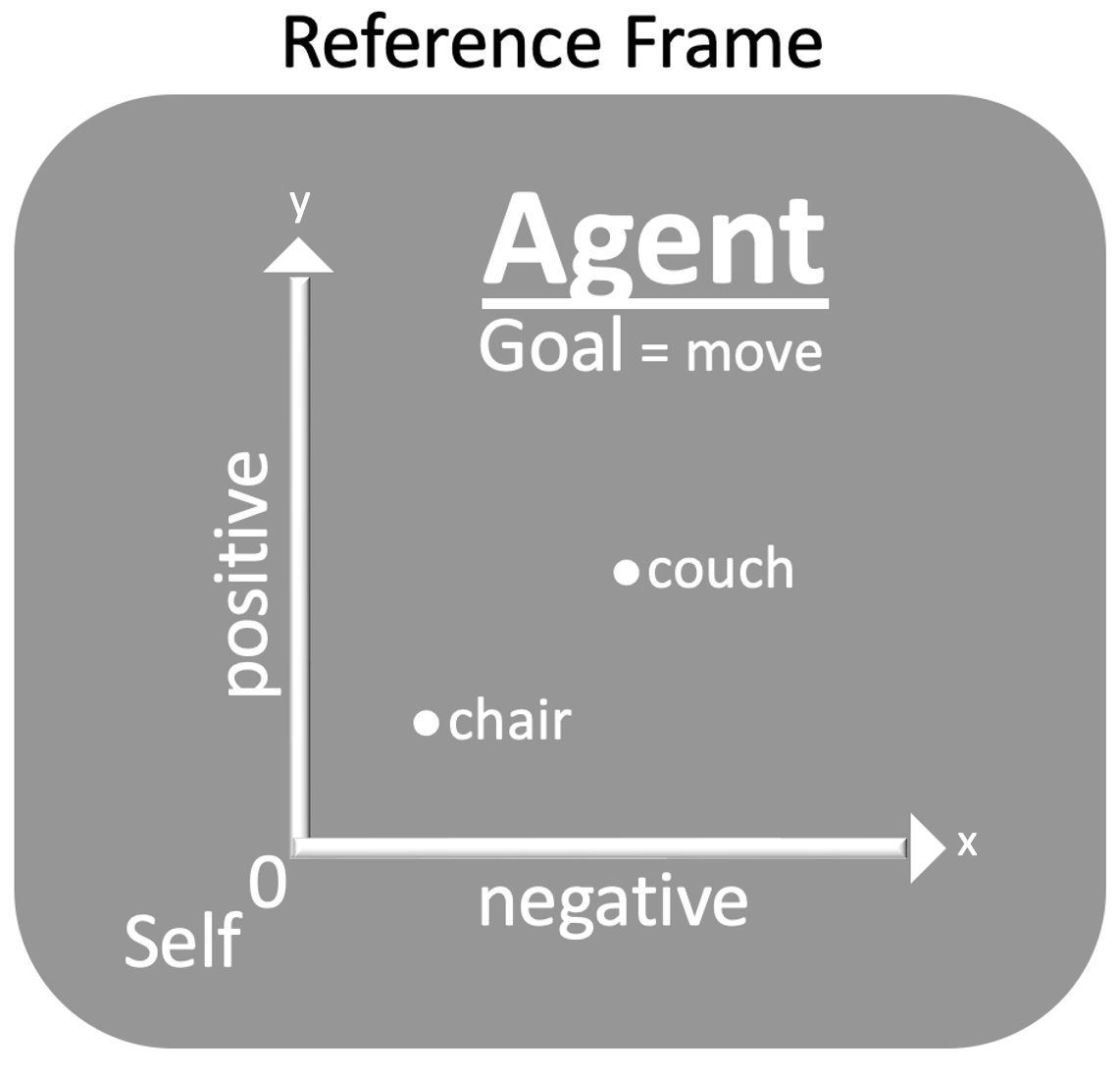
(Note: Search for means: average weight a person can lift – weight of potential items. Chair (weight x) takes less effort (agent y) to move then couch (weight x).)
The final product is a RFM with associative factors incorporated:
- The system produces complimentary x-y factors to build the RF model.
- The factors are used to make predictions that correlate with the situation.
- The model virtually knows what’s in play to predict a variety of outcomes.
The newly rendered orientation can be repurposed i.e., factors can change:
- Move this, that or the other thing e.g., move the vase.
- Moving this is like moving that e.g., vase is like lamp.
Reasons to move the couch belong to Y of Agent (or more RFMs can apply).
- Factors can be incorporated or rejected as can RFMs
It gets interesting when repurposing involves multiple RFMs and layers.
- E.g., “That couch is as stubborn as my dog.”
- RFMs: [pet]>[behavior]>[move_things]

Orientation repurposed is Word-Sensibility.
(Note: The processes applied to this example generally apply to all text analyses).
Cognition generally described are coupled dynamical systems nested between, nervous system and body – body and brain – brain and environment. — Randell D. Beer
d) Word-Sensibility Theory:
When we read something we recall the dynamic sense of our experiences:
- Situational sense is the potential sense of one’s actual dynamic sense.
- Dynamic sense can be literally or figuratively matched to a situation.
The goal is about rendering the best orientation available to the agent.
- Here, dynamic sense refers to experiences used to orient one to a text.
- It always begins as a spatial-temporal analog that be literal or figurative. .
- Orientation does not assess if a text applies literally or figuratively.
- Understanding what is literal or figurative is a secondary process.
- Orientation-dynamics is not about providing the necessary truth conditions.
- Orientation-dynamics is necessary before truth conditions can be targeted.
- An orientation once coupled to a situation becomes a situational-viewpoint.
(Note: The situational-viewpoint is a relator to other viewpoints or orientations.)
Orientation is actual dynamic sense as context for the occurrent potential.
• Orientation is about responding positively to a situation with actual and potential dimensions. Quadranym units prime the process: y axis is always potential while x axis is always actual. The zeropoint is always actual while the coordinates is always potential i.e., [Potential(actual) ➝ Actual(potential)].
Layered system example for: Let’s move the couch over there.
A Spatial-Temporal System of Orientation (Quadranyms):
- RF ∞……[Potential(actual) ➝ Actual(potential)] = source
- Space……..[Infinite(void) ➝ Finite(between)] = source
- Time…………[Future(present) ➝ Past(event)] = source
- Distance..[There(position) ➝ Here(relation)] = source
- Energy….[Active(motion) ➝ Passive(matter)] = source
- Agent……[Positive(self) ➝ Negative(goal)] = source
- Agent…..[Positive(Let’s) ➝ Negative(move)] = target w/text
- Time……..[Future(the_couch) ➝ Past(move)] = target w/text
- Distance..[There(move) ➝ Here(over_there)] = target w/text
- Energy..[Active(move) ➝ Passive(the_couch)] = target w/text
Prime RFs such as RF ∞ are like analogs for new RFs. It’s like morphing:
- RF ∞ essentially repeats for each lower topic but is synergized with topic.
(Note: A quadranym is a play toward operating as an active or effective relater.)
Units can be Added, Reordered, Removed or Refactored:
- General source layers.
- Relevant target layers.
(Note: Nested layers form flow lanes through the layers of a system. Flow lanes permit metaphoric relations – and allow relevant layers to infer general layers.)
The next section will elucidate the relationships between nested layers and reference frames. It’s about how the hierarchy controls access-to-reference.
- A relevant layer has little reference to the general layer(s) it’s nested in.
(Note: e.g., The brain shifts a large portion of its tasks to unattended habits.)
The misconception which has haunted philosophic literature throughout the centuries is the notion of ‘independent existence.’ There is no such mode of existence; every entity is to be understood in terms of the way it is interwoven with the rest of the universe. ― Alfred N. Whitehead
e) Nested Layers Theory:
Quadranym Representation:
General Quadranym for ENERGY: active, passive, matter, motion
(Note: motion ➝ matter = engagement. active ➝ passive = behavior.)
Phrase Template (PT):
- For the motion-ness of ENERGY;
- active is dependent on passive to find matter.
PT Mode Variants:
- work is dependent on power to find matter
- size is dependent on weight to find matter
Alternates:
- Applies Generally: (∀x) energy(x) ⟹ [Active(motion) ⊇ Passive(matter)(x)]
- More Specifically: (∀x) energy(x) ⟹ [Available(power) ⊇ Deplete(fuel)(x)]
A quadranym is the basic unit of a faceted classification scheme. Any topic is analyzed into its component parts beginning with the prime dimensions.
Prime Dimensions:
- Time: Subjective is the zeropoint for Objective temporal measure.
- Space: Expansive is dependent on Reductive to find spatial measure.
(Note: Above is a scheme for a (relative) spatial-temporal sense of measure.)
 (Note: Like we transition space we transition time e.g., move meeting forward, push deadline back, attend long event or go on short break = in terms of another.)
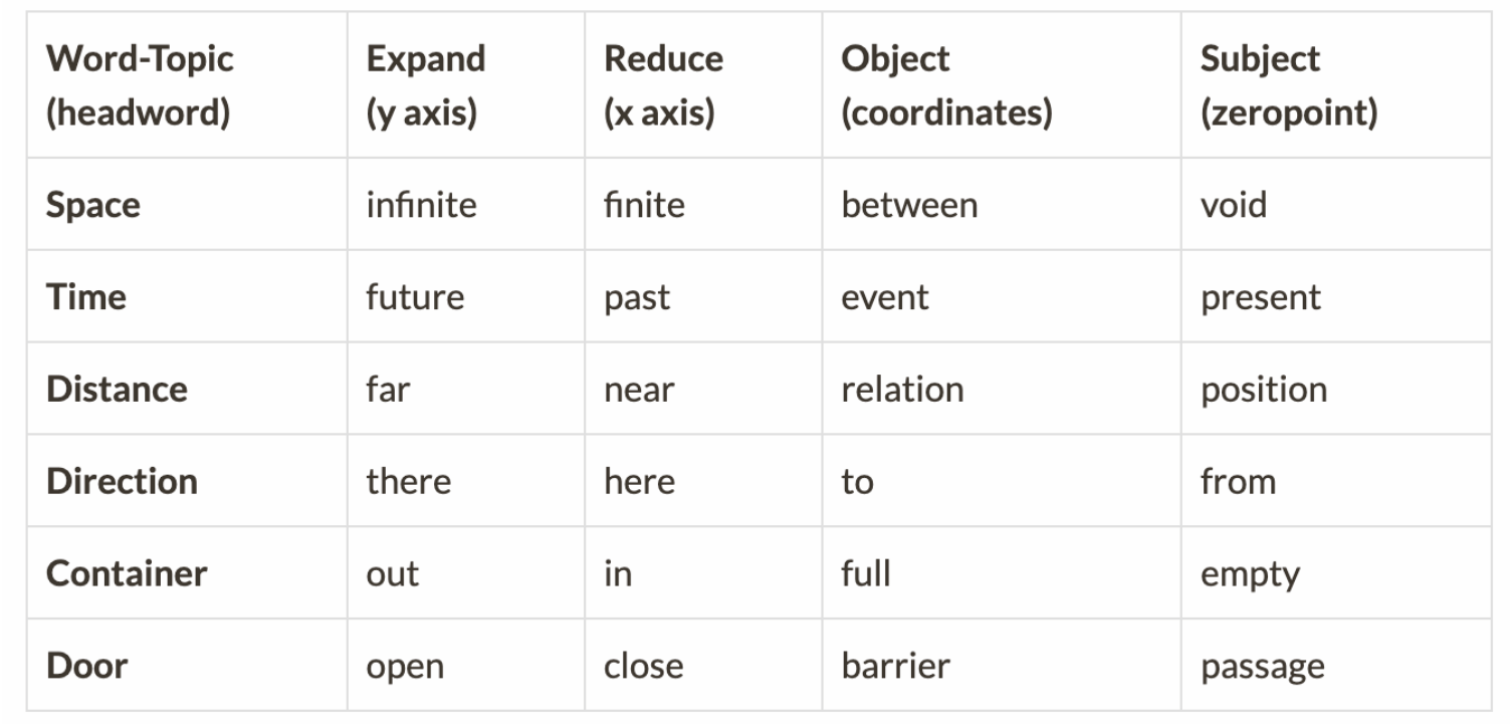
Above shows a chart of quadranyms in an hierarchical order from space to door. The hierarchical layers (word-topic file) do not provide subjective and objective distinction. This distinction is only on quadranym ranks. Any gap between subjective and objective conditions is expressed in scripts. Scripts represent the relationships between Q units on a single layer. Hierarchical layers provide the ecology from which subjective and objective states form.
- The hierarchical layers represent all ecological factors of the system.
- Quadranyms represent subject and object distinction for each layer.
- Scripts represent the relationships between the subject–object units.
(Note: Key to the ecology analog is systemic relations e.g., biotic ➝ abiotic.)
Find Spatial Measure

System layers respond to circumstances with each layer’s target potentials.
- A system is like an occasion of wholeness ― each layer seeking satisfaction.
(Note: Any layer of any system is a virtual self identification opportunity. Think of the Q system as a way to assemble viewpoints to the potentials of circumstance.)
Enabling Constraint System: Higher layers control access-to-reference.
Access-To-Reference:
- Higher layers represent unattended sense.
- Lower layers represent attended sense.
• Lower layers are anchored and enabled by the general content of the higher layers. Higher layers conserve the orientation and point of view.
(Note: Q nested hierarchical systems prevent the lower layers from referencing the higher layers. For instance, it may be helpful to imagine nested Russian dolls, each doll can reference the dolls it contains but not the dolls that may contain it.)
Any task is a ratio between the attended and the necessary unattended.
Example:
‘Unattended’ Orientation System A:
- General; Environment: Space-Time
- Middle; Intention: Energy
- Relevant; Task: Agent
Above: Agent with task driven by Energy nested in Space–Time.
(Note: Associated variants are specific to the general concepts of System A.)
Again, consider the sentence: Let’s move the couch over there.
‘Attended’ Text Orientation System B:
- General: Agent(let’s)
- Middle: Time(The_couch)
- Middle: Space(over_there)
- Relevant: Energy(move)
Above: Relevant to the Agent is reference to time, space and energy.
- Orientation system A can be used to anchor orientation system B.
Agent does task with attended sense. Unattended sense enables it.
(Note: There are general & relevant units as well as general & relevant systems. Hyper nested system layering is when systems nest into or with other systems.)
What we call knowledge does not and cannot have the purpose of producing representations of an independent reality, but instead has an adaptive function. ― Ernst von Glasersfeld
f) Adaptive Layers Theory:
Layers are arranged and rearranged to suit the occurrent encounter.
- E.g., Interpersonal orientation often adjusts when an adult speaks to a child.
Interpersonal orientation is an intentional activity that requires work.
- To virtually save energy layered systems become normalized.
Normative layers automatically provide the unattended aspect.
- Normative orientation provides a short cut to what’s relevant.
(Note: Normatives include personal orientation and interpersonal orientation.)
In a sense, the more a system can change the more ecological it is. The more a system resists change the more hierarchical it is (i.e., change and resistance).
- Hierarchal systems virtually develop through the ecology of experience.
Normative systems are habits and can be analogous to social conventions.
- Consider why societies build these systems up and then tear them down.
Problems arise when the relevant topic is limited by the convention.
- e.g., Consider social political issues or being an outsider of a group.
Each individual has deep normative layers that inform their orientation.
- Orientation is an idiosyncratic activity approximated between individuals.
(Note: Presuppositions: ideas or assumptions taken for granted. They may be true or false. We often assume they are shared by others but frequently not.)
In a way, civilization is to society what intelligence is to the individual.
- Content justification is more than the orientationality between individuals.
(Note: In God we trust; all others bring data. – W. Edwards Deming. E.g., truth intentions: control and prediction, and confirmation of appearance to reality.)
Orientation is methodology for sharing data; not justification for data.
- Methodology justifies that which produces the data for analyses.
- Epistemology modifies methodology and justifies the knowledge.
- The dynamical context alone is never an understanding.
- The situation is understanding, waiting to be related to.
(Note: The last statement is about the pressures that drive the organism. Dynamical context is responsive expectation buffering world encounters.)
The human mind adapted to a symbolic culture, thus, extending biological memory out to function within a culture. ― Merlin Donald
g) Nested Scripts Theory:
The last part of the process requires its own article. Basically, a script is linking quadranyms together on a single layer thus creating a time-line.
- Time-lines cycle at different lengths on different layers as a system.
Script Units:
- [Y(subject) -> X(object)]<gap>[Y(subject) -> X(object)]<gap>[Y(subject)…
Scripts link subject-object units i.e., X(object__?) <link> Y(subject__?)
- [Y(a) -> X(b)]<link>[Y(b) -> X(c)]<link>[Y(c) -> X(d)]<link>[Y(d) -> X(e)]…
(Note: e.g., rock <becomes> tool, plant <becomes> food, noise <becomes> music)
Layered time-lines can stretch out into one long time consuming time-line.
- The more layers a system can nest into the more virtual time it can save.
(Note: Script System: nested timescales; feedback; adaptive organization.)

Agent Template:
- [Active_Potential(active_actual) -> Passive_Actual(passive_potential)]
Intention Template:
- Active energy represents a unit using power e.g., organismic energy.
- Passive energy represents a power being used e.g., environmental resource.
- active sense represents more experience necessary i.e., find relation.
- passive sense represents no more experience necessary i.e., relation found.
(Note: active sense & novelty (solving). passive sense & familiarity (solved.)
Text Example:
- [Y(Let’s) -> X(move)]<>[Y(move) -> X(couch)]<>[Y(couch) -> X(there)]<>
Script Repurposed (or entailment):
- [Y(Let’s) -> X(move)]<>[Y(move) -> X(selves)]<>[Y(selves) -> X(there)]<>
Quadranym Unit Template:
- [Mode(state) -> Mode(state)]<find>[Mode(state) -> Mode(state)]<find>
Script Conditions Template:
- [Y(source) -> X(target)]<>[Y(source) -> X(target )]<>[Y(source) -> X(target)]
(Note: New scripts can be created by mix and matching source and target units. New reference frames are created by individuating and utilizing a script unit.)
Scripts are more like episodic memories, memories about the events in life and how they relate to us. And less like semantic memories, memories about facts and concepts about the world. Scripts are about doing things.
(Note: Scripts have a linear kind of scale while layers are more logarithmic.)
Human self awareness is a form dependent on the intentional forms we share with others. ― Michael Tomasello.
h) Interpersonal Orientation Theory
• In theory, word-sensibility is not about different ways of reasoning but about different ways of coping. Here, coping reflects the social-dependent nature of the human species, a dependence that language represents; we require cultural definition of expectations. Defining expectations helps to lower anxiety levels and provide a mutual area of focus and anticipation.
What emerges from a society are basic orientations that members share.
- In some part, orientation emerges naturally but; it is also a learned skill.
Orientation is a natural practice related to social habits, rituals & traditions.
- Orientation is probably best described in terms of dynamic systems theory.
Takeaway: Word-sensibility is a model for systemic lexical orientation.
(Note: The aim is to meld intra-subjective systems with inter-subjective systems.)
3. Summing-Up
The organism’s environment is the sense it makes of the world. This environment is a place of significance and valence, as a result of the global action of the organism. — Evan Thomson
Reference frames nest into various hierarchical layers (i.e., from general to relevant). These nested layers form virtual systems of responsiveness. The approach aims to assist with hard Artificial General Intelligence (AGI) tasks.
Such as:
Ultimately, the goal is to enable machines the ability to share viewpoints.
- Topic interoperability is the ability to adopt or reject the topic orientations of other AI systems. Competitive performance comparisons advance schemes.
Q system reference frames can be used with deep learning models, that utilize word embedding methods, to orient the word associations learned.
- Data training: database, knowledge graphs, ontology and open text.
The aim was to provide the basic components of the model. In future blogs we’ll show a variety of analysis examples and discuss different applications.
-
Quadranyms can aptly match to words, sentences or other chunks of text.
(Note: Reference frames are populated by quadranyms. See: nymology.org. A quadranym is the basic unit of a faceted classification scheme (Q). Any topic is analyzed into its component parts beginning with the prime quadranym classes.)
Review Points of Discussion:
Visit the About page for the project’s motivation, scope and goals. We are in the exploratory stage and look forward to any feedback. Please Contact.
See: General References
Pivotal Inspiration: Alfred North Whitehead & Philosophy of Organism
Actual entities involve each other by reason of their prehensions of each other. There are thus real individual facts of the togetherness of actual entities, which are real, individual, and particular, in the same sense in which actual entities and the prehensions are real, individual, and particular. Any such particular fact of togetherness among actual entities is called a ‘nexus’ (plural form is written ‘nexūs’). The ultimate facts of immediate actual experience are actual entities, prehensions, and nexūs. All else is, for our experience, derivative abstraction (PR 20).
― Alfred N. Whitehead, Process and Reality

Eros & Psyche

Drafts - Work In Progress - Do Not Quote Or Distribute
© 2018 buildintuit.com All Rights Reserved
 Build Intuit