
Article Expanded:
Orientational Persistence: What It Is, Why It Matters, and Who Studies It
1. What is orientational persistence?
Orientational persistence is the capacity of a system to maintain a coherent orientation through changing circumstances without simply preserving or recovering its previous state.
An orientation establishes how a system is positioned relative to its environment, its own activity, and the possibilities available to it.
Persistence means that this organization continues to influence subsequent encounters, even when the circumstances change.
Consider a person walking across uneven ground. Each step changes the relationship between the body, its movement, and the supporting surface. The person does not recover an identical previous posture. Instead, the body continuously reorganizes while preserving the deeper coordination that makes walking possible.
The important distinction is:
- State persistence: Something remains unchanged.
- Memory: Something previously experienced can be recovered.
- Orientational persistence: An inherited organization continues to constrain how new circumstances are encountered, measured, and acted upon.
Orientational persistence therefore involves both continuity and transformation.
Its defining problem is how an organization can remain itself while changing what it is doing.
2. Why is orientational persistence important?
Intelligent behavior requires more than responding appropriately to individual situations. It requires continuity between situations.
A system that cannot preserve orientation must repeatedly reconstruct its relationship to the world. It may respond correctly to each immediate circumstance yet fail to maintain coherent behavior over time.
Orientational persistence is important for several reasons.
Adaptive stability. Organisms must adjust to disturbances without losing the organization that makes coordinated activity possible.
Learning and development. New experiences must modify inherited organization rather than simply replace it. What persists constrains what can be learned next.
Agency. Goals and intentions must remain operative across interruptions, environmental changes, and competing demands.
Identity and continuity. A system can undergo substantial changes while retaining recognizable patterns of organization.
Artificial intelligence. An AI system may reconstruct earlier context from memory without retaining an operative orientation through which that context continues to matter.
This last distinction is especially significant for long-horizon AI systems.
An LLM can retrieve an earlier decision and describe it accurately. That does not necessarily mean the decision has persisted as an organizing constraint on subsequent behavior.
Recovering the past is not the same operation as continuing from the past.
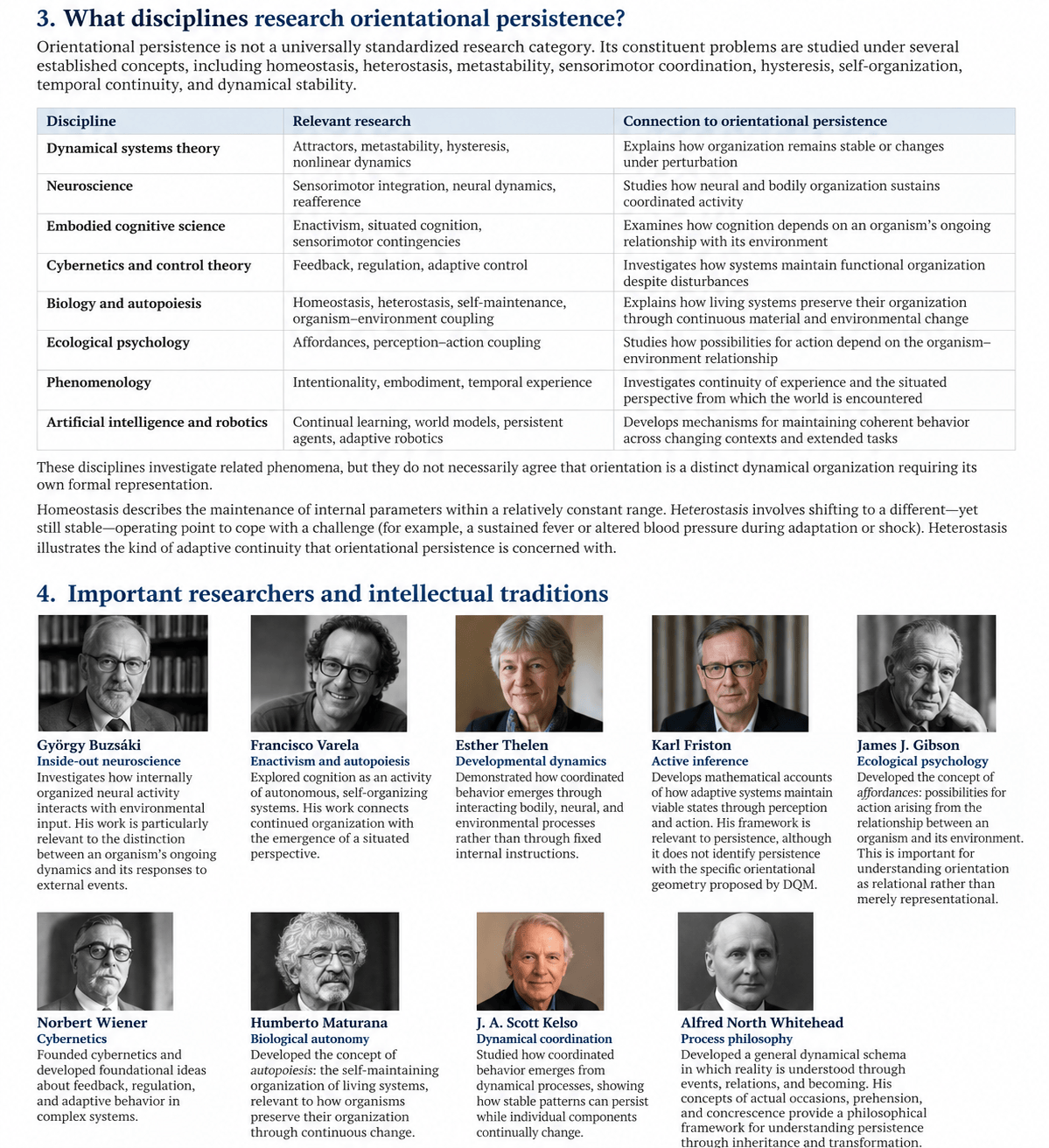
3. What disciplines research orientational persistence?
Orientational persistence is not a universally standardized research category. Its constituent problems are studied under several established concepts, including homeostasis, heterostasis, metastability, sensorimotor coordination, hysteresis, self-organization, temporal continuity, and dynamical stability.
| Discipline | Relevant research | Connection to orientational persistence |
|---|---|---|
| Dynamical systems theory | Attractors, metastability, hysteresis, nonlinear dynamics | Explains how organization remains stable or changes under perturbation |
| Neuroscience | Sensorimotor integration, neural dynamics, reafference | Studies how neural and bodily organization sustains coordinated activity |
| Embodied cognitive science | Enactivism, situated cognition, sensorimotor contingencies | Examines how cognition depends on an organism’s ongoing relationship with its environment |
| Cybernetics and control theory | Feedback, regulation, adaptive control | Investigates how systems maintain functional organization despite disturbances |
| Biology and autopoiesis | Homeostasis, heterostasis, self-maintenance, organism–environment coupling | Explains how living systems preserve their organization through continuous material and environmental change |
| Ecological psychology | Affordances, perception–action coupling | Studies how possibilities for action depend on the organism–environment relationship |
| Phenomenology | Intentionality, embodiment, temporal experience | Investigates continuity of experience and the situated perspective from which the world is encountered |
| Artificial intelligence and robotics | Continual learning, world models, persistent agents, adaptive robotics | Develops mechanisms for maintaining coherent behavior across changing contexts and extended tasks |
These disciplines investigate related phenomena, but they do not necessarily agree that orientation is a distinct dynamical organization requiring its own formal representation.
Homeostasis and heterostasis
Homeostasis describes the regulation of internal parameters, such as body temperature or blood pH, within relatively stable ranges.
Heterostasis describes adaptation involving a shift toward a different operating condition or regulatory baseline in response to changing demands.
Where homeostasis emphasizes maintaining regulated conditions, heterostasis emphasizes adaptation that may establish a new condition rather than simply restoring the previous one.
Heterostasis offers a useful analogy for orientational persistence: an organization can maintain continuity while its particular operating states change.
The two concepts are not mutually exclusive, and their usage varies across physiological traditions. DQM concerns orientational rather than specifically physiological persistence.
4. Important researchers and intellectual traditions
György Buzsáki — Inside-out neuroscience
Investigates how internally organized neural activity interacts with environmental input. His work is particularly relevant to the distinction between an organism’s ongoing dynamics and its responses to external events.
Francisco Varela — Enactivism and autopoiesis
Explored cognition as an activity of autonomous, self-organizing systems. His work connects continued organization with the emergence of a situated perspective.
Esther Thelen — Developmental dynamics
Demonstrated how coordinated behavior emerges through interacting bodily, neural, and environmental processes rather than through fixed internal instructions.
Karl Friston — Active inference
Develops mathematical accounts of how adaptive systems maintain viable states through perception and action. His framework is relevant to persistence, although it does not identify persistence with the specific orientational geometry proposed by DQM.
James J. Gibson — Ecological psychology
Developed the concept of affordances: possibilities for action arising from the relationship between an organism and its environment. This is important for understanding orientation as relational rather than merely representational.
Alfred North Whitehead — Process philosophy
Developed a general dynamical schema in which reality is understood through events, relations, and becoming. His concepts of actual occasions, prehension, and concrescence provide a philosophical framework for understanding persistence through inheritance and transformation. The relevance to DQM is schematic, rather than an adoption of Whitehead’s full metaphysical account.
Other important traditions include the cybernetics of Norbert Wiener, the biological autonomy work of Humberto Maturana, and the dynamical coordination research of J. A. Scott Kelso.
5. Where the Dynamic Quadranym Model differs
The Dynamic Quadranym Model (DQM) approaches orientational persistence as a problem of inherited tension and its continued capacity for differentiation.
Its central claim is not merely that an orientation remains stable. Rather, an orientation persists only insofar as its inherited organization remains capable of accommodating new circumstances through further determination.
The quadranym provides a formal unit:
T:[Y(a) → X(b)]
Here, a supplies the inherited subjective anchor, Y and X establish the potential and actual modes of measurement, and b expresses the objective potential determined through their intersection.
The resulting b is not automatically a resolution. Persistence requires further adjudication across orientational layers. A definitive point establishes whether a determination is coherent enough to permit hysteretic progression.
This produces a distinctive sequence:
Inherited orientation
Organization carried forward from earlier encounters.
↓
Perturbation and differentiation
New circumstances exert pressure on inherited tension.
↓
Modal determination
Y depends on X to determine b from a.
↓
Cross-layer adjudication
Coherence and hysteretic legality are evaluated.
↓
Permitted persistence
Organization remains available to constrain later encounters.
This differs from treating persistence simply as a stable attractor, stored representation, or remembered state.
DQM proposes that the system’s orientational history remains operative through its capacity to differentiate again.
Its use of hierarchical quadranyms (HQs), local quadranyms (QUs), and nested orientations is intended to provide an explicit grammar for this process.
That remains a theoretical and computational proposal, rather than an experimentally established account of orientational persistence.
6. Why this matters for artificial intelligence
The distinction becomes particularly clear when comparing the two proposed regimes of an LLM–DQM architecture.
| LLM — Situational Context (SC) | DQM — Dynamical Context (DC) |
|---|---|
| Reconstructs what is relevant to the present situation | Maintains inherited orientational organization |
| Predicts semantic continuations | Evaluates the viability of orientational continuations |
| Retrieves earlier context when needed | Carries forward positions that remain permissible |
| Optimizes contextual coherence | Seeks coherence across successive orientations |
| Operates primarily through semantic relationships | Operates through modal and statal relationships |
The proposed coupling allows semantic information to perturb orientation while inherited orientation constrains subsequent semantic continuation.
The LLM supplies what has changed. The DQM carries what has not yet been defeated by that change.
This is not a claim that existing LLMs have no persistent mechanisms. Rather, it distinguishes context retention and memory retrieval from the specific form of orientational inheritance DQM seeks to implement.
7. The fundamental research question
The broader scientific problem can be expressed as follows:
How can a system preserve the organization that makes its activity coherent while continually changing the particular states, relationships, and circumstances through which that organization is expressed?
Dynamical systems theory investigates stability and transformation. Neuroscience investigates continuing neural organization. Biology investigates self-maintenance. Embodied cognition investigates situated activity. AI investigates persistent, adaptive computational behavior.
DQM attempts to connect these problems through an explicit grammar of orientation, measurement, hysteresis, and inheritance.
Its potentially distinctive contribution is the proposal that persistence is neither the preservation of an old state nor the recovery of an old representation, but the continued operation of inherited orientational tension under new conditions.
Whether that grammar provides explanatory and computational advantages beyond existing approaches is the central empirical question.

