
What is a Quadranym?
States: Subjective, Objective
Modes: Expansive, Reductive
It does not represent meaning; it represents orientation already real and coherent. It is not truth-conditional or propositional. It targets the proposition against its present coherence and history.
Quadranym Model: Prime Dimensions of Orientation
On this site, we introduce the concept of “word-sensibility,” which aims to help machines navigate commonsense knowledge in a human-like way by focusing on the way people form expectations based on context. The idea is to break down human experience into manageable pieces at the word level, allowing machines to interpret and respond to situations more effectively.
Since machines lack direct experience of the world, they struggle with commonsense reasoning. By analyzing text and assessing the meanings of words in relation to human responsiveness—how people quickly and positively react to various situations—the main goal is to create a framework that enables machines to better understand the environment people operate in. We introduce the Quadranym framework for this task.
The Quadranym is a way to model the way we orient to things.
Quadranym Examples: (From: Nymology.org)
Nested General Topics

Quadranym (Definition)
A quadranym is a minimal orientation unit that organizes coherence across four functional roles:
Expansive (drive, opening, generative spread)
Reductive (constraint, closure, selection)
Subjective (origin, perspective, situated initiation)
Objective (intersection, constraint by situation, shared structure)
A quadranym does not represent meaning, propositions, or truth conditions. Instead, it provides an orientational geometry that is already real and coherent, against which representational content can be tested, stabilized, and modulated.
Quadranyms operate through the coupling of two contexts:
Situational context — supplies diction, reference, and truth-conditional contact.
Dynamical context — supplies coherence, inertia, responsiveness, and hysteresis.
The quadranym itself encodes neither truth nor semantics. It functions as a local stability scaffold that higher-order scripts, procedures, or representational systems iterate over. Through this iteration, propositions are evaluated not directly for truth, but for fit against present and historical coherence.
In this way, a quadranym targets propositions relative to their coherence trajectory, enabling responsive adjustment while preserving orientational continuity across time and context.
Role Matrix (EROS)
Axis | Function | Orientation Role
Mode | Expansion | Generative spread, openness
Mode | Reduction | Constraint, pruning
State | Subjective | Origination, perspective
State | Objective | Intersection with situation
Functional Character
Primitive (not decomposed into semantic parts)
Non-propositional
Non-representational
Coherence-distributing rather than meaning-bearing
Enables hysteretic testing and modulation of representations
Stabilizes orientation prior to, and beneath, truth evaluation
The Quadranym Word-Sensibility Model is a Multi-Context System.
• A quadranym is a suggested orientation to a topic. Orientations can be modified, evolved or changed out completely for another orientation unit.
(Note: Quadranyms are latent general topics that match to words or sentences. The quadranym model is a method of text analyses for apt general orientation.)
Phrase templates (PT) are used to test quadranyms.
- A PT should apply naturally to all the quadranyms of its domain.
PT Example:
PT: expansive(E) is dependent on reductive(R) to find the objective(O) of subjective(S) e.g., open is dependent on close to find the barrier of passage.
Word-Topic: Door
- E = open
- R = close
- O = barrier
- S = passage
The door orientation is nested into the space orientation.
Word-Topic: Space
- E = Infinite
- R = finite
- O = between
- S = void
(Note: The general topic door is considered a realm of the spatial domain topic. The quadranym taxonomy of layers is domain, realm, class, type; each a topic.)
Quadranyms populate reference frame models.
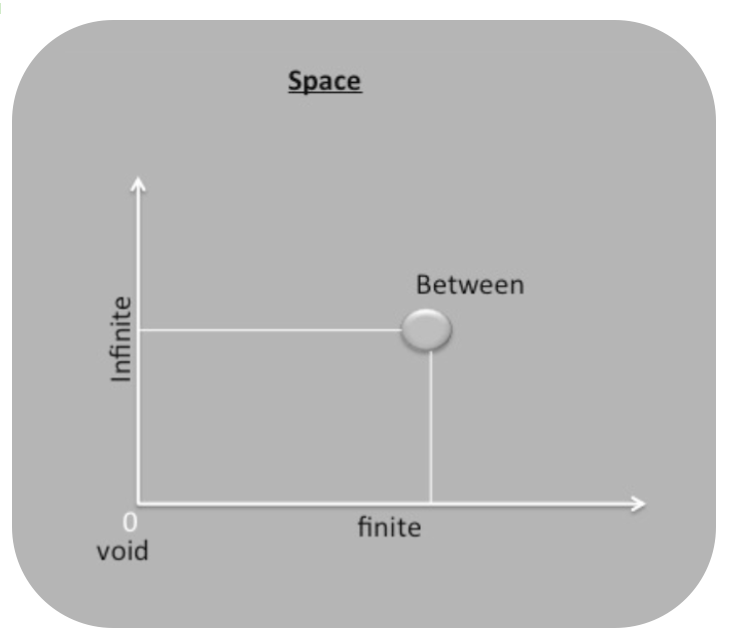
Reference Frame Model Example:
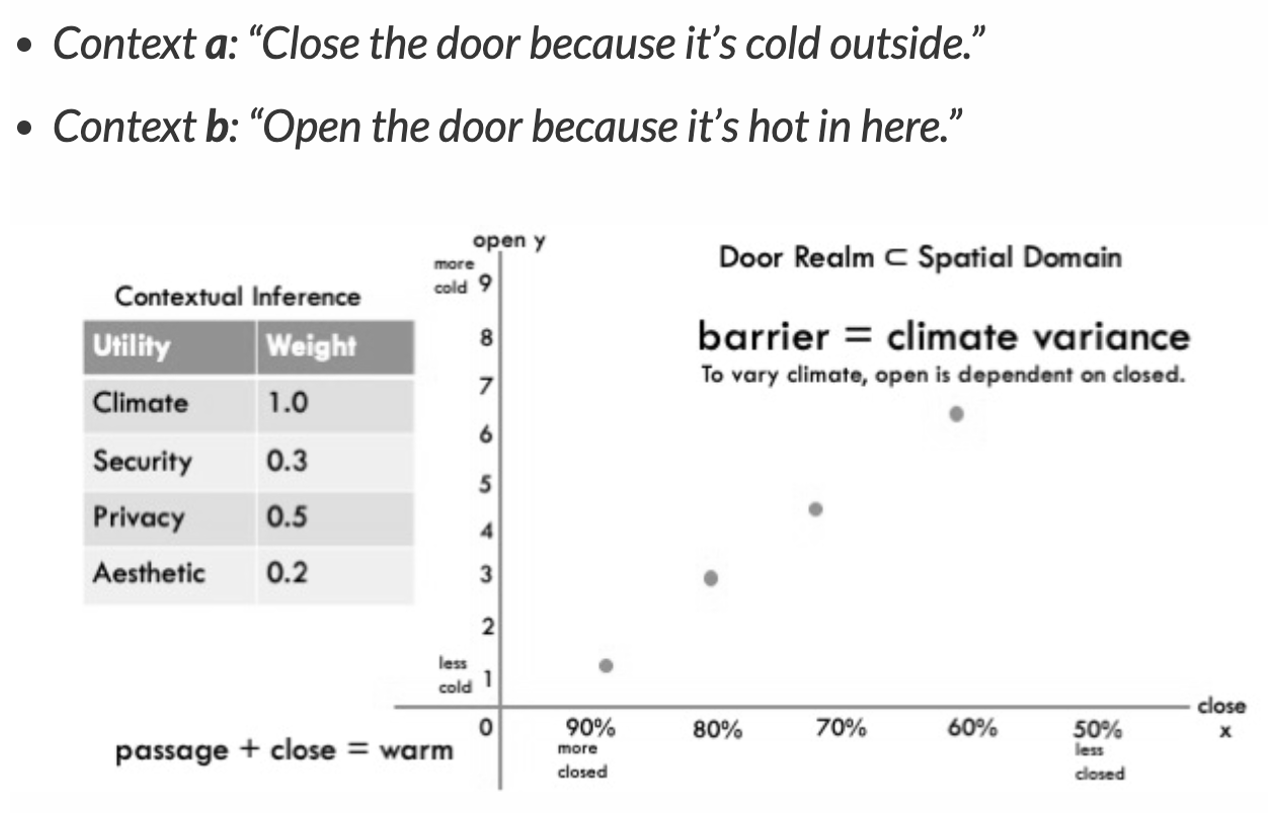
Ways to Think About Quadranym Dimensions:
The Quadranym Square

A quadranym is the basic unit of a faceted classification scheme. Any topic is analyzed into its component parts beginning with the prime quadranym unit:
- Prime Dimensions: E.R.O.S.
General Sense Categories:
- E Mode: Expansive sense category
- R Mode: Reductive sense category
- O State: Objective sense category
- S State: Subjective sense category
- (∀x) topic(x) ⟹ [E(s) ⊇ R(o)(x)]
Reference Frame Model:
- E Mode: Dependent Y variable
- R Mode: Independent X variable
- O State: Target condition state
- S State: Source condition state
- (∀x) topic(x) ⟹ [Y(source) ⊇ X(target)(x)]
Superset-Subset of Modes & States:
- E Mode: Potential action (superset)
- R Mode: Actual measure (subset)
- O State: Conditional sense (subset)
- S State: Coherent sense (superset)
- (∀x) topic(x) ⟹ [Action(coherent) ⊇ Measure(conditional)(x)]
(Note: The set-type is the factor that represents the dimension that describes or modifies the other factors of the set. Superset all factors | Subset some factors.)
Basic Template: Potential(actual) ⊇ Actual(potential)
- Example: Play(child) ⊇ Bouncy(ball)
The quadranym is a mental construct implying embodied simulation. The aim is a simple categorical representation of dynamic human-orientation.
- Capturing a hint of real world systemicity for AI communication programs.
(See additional information on the home page: Model Overview.)
Categories form around and (or) are mentally represented by salient or information rich or highly imaginable stimuli which become prototypes for the category. Other items are judged in relation to these prototypes; that’s the way they form gradients of category membership. There don’t need to be any attributes which all category members have in common — no defining attributes — and category boundaries don’t need to be definite. This is exactly counter to the view of categories as logic.
― Eleanor Rosch
Quadranym Scripts:
Orientation Example: What is a bird?
- People usually answer by recalling a typical bird or what birds typically do.

- States: The assertion “that’s a bird” claims all birds (the aboutness of).
- Modes: The assertion “birds fly” also claims all birds (the action of).
The two diagrams above should, at first, seem backward from a normal kind of taxonomy. But what it represents is an active sense of all birds. Not all birds are prototypes and not all birds fly. But the intention of the prototype is to target all types. Birds that fly is a measure of birdness that can be reduced to all birds have feathers. The diagrams represent the categories of the orientation to the subject.
- Typical Orientation: What isA Bird: [Fly(prototype) ⊇ Feathers(types)]
Map Above to the Basic Template: Potential(actual) ⊇ Actual(potential)
Evolve to solve: Birds that fly are indeed a type of bird. Are there other types?
Evolving Orientations (e.g., taxonomic script):
- Evolving condition states: [Y(prototype) ➝ X(type)]<find>[Y(type) ➝ X(?)]
A State Set Orientation Becoming a New State Set Orientation.

The evolving orientation is about discovering new birds (the difference of).
- Evolved Example: What isA Bird: [Y(type) ⊇ X(class)]<find>[Y(class) ⊇ X(?)]
The new orientation finds a new target, class. It becomes a new orientation.
- The type of bird that doesn’t fly forms a class of bird called flightless birds.
In the model, all concepts require orientation to target the situation.
The key to quadranym categorical thinking is active sense as apposed to passive sense. Passive sense is predigested categorical thinking; it is knowing that when you role out of bed in the morning the floor will be there or that ‘this C follows that B’. Active sense is the process that will get you there. It’s about the solving between orientation and the situation, between the self and real world changes.
- Active sense refers to generating orientation i.e., FROM general TO relevant
- Passive sense refers to achieving conditioning i.e., FROM specific TO general
 Build Intuit