
Let’s break down how each formula could apply within the DQM:
- Granular Recursive Transition Across Layers Formula: TLi→Li+1=∫0TPLi(t)⋅ffeedback(t)dt
- Application in DQM: This formula directly models the “Inter-layer Coupling Dynamics” mentioned in the DQM text. Each “Li” represents a layer in the DQM’s hierarchical structure (e.g., a unit layer, a script layer, a broader system layer).
- PLi(t) (Probability of stable/resolved orientation): This could represent the probability that a specific quadranym (or a set of quadranyms within a layer) has reached a state of coherence or resolution at time t. For example, in the “door” example, PLi(t) could be high when the system’s orientation to “passage” is stable and “ready-to-hand.”
- ffeedback(t) (Feedback modulation): This is crucial for the DQM’s “Dynamic Feedback Loop” and the “Active-Passive Cycle.” It reflects how the system dynamically adjusts its transition based on internal recalibration. If a quadranym’s coherence is disrupted (e.g., “barrier” becomes “present-at-hand”), ffeedback(t) would modulate the transition to the next layer to reflect this need for reorientation. The integral sums up these dynamic, feedback-modulated transitions over time, capturing the continuous flow of meaning-making across layers.
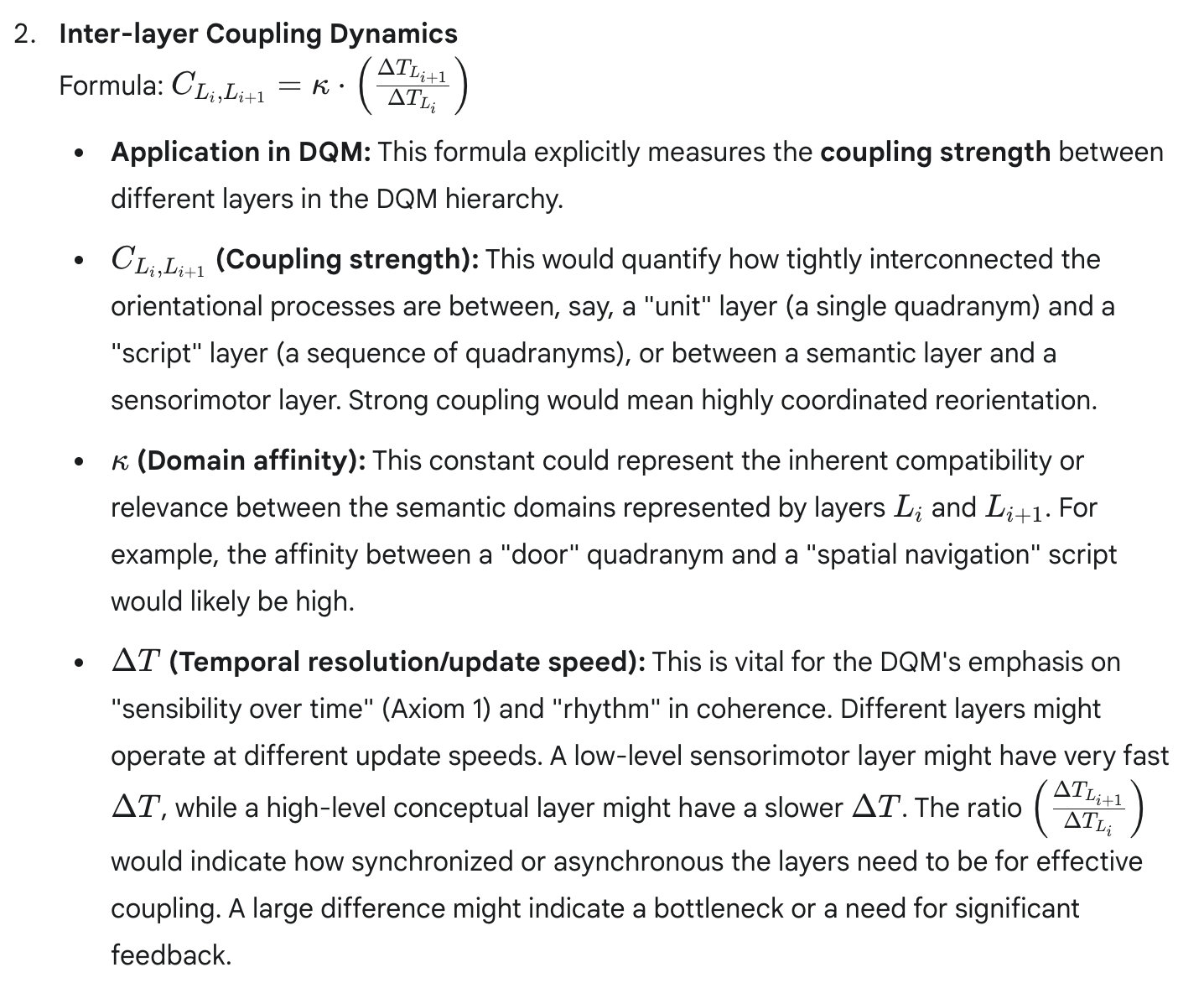
- Inter-layer Coupling Dynamics Formula: CLi,Li+1=κ⋅(ΔTLiΔTLi+1)
- Application in DQM: This formula explicitly measures the coupling strength between different layers in the DQM hierarchy.
- CLi,Li+1 (Coupling strength): This would quantify how tightly interconnected the orientational processes are between, say, a “unit” layer (a single quadranym) and a “script” layer (a sequence of quadranyms), or between a semantic layer and a sensorimotor layer. Strong coupling would mean highly coordinated reorientation.
- κ (Domain affinity): This constant could represent the inherent compatibility or relevance between the semantic domains represented by layers Li and Li+1. For example, the affinity between a “door” quadranym and a “spatial navigation” script would likely be high.
- ΔT (Temporal resolution/update speed): This is vital for the DQM’s emphasis on “sensibility over time” (Axiom 1) and “rhythm” in coherence. Different layers might operate at different update speeds. A low-level sensorimotor layer might have very fast ΔT, while a high-level conceptual layer might have a slower ΔT. The ratio (ΔTLiΔTLi+1) would indicate how synchronized or asynchronous the layers need to be for effective coupling. A large difference might indicate a bottleneck or a need for significant feedback.
- Boundary Thresholds for Reorientation Formula: PBoundary(A→P,t)=Pthreshold(A→P)⋅fcontext(t)⋅faction(t)
- Application in DQM: This formula directly applies to the DQM’s notion of “disrupted coherence” and the transition from “ready-to-hand” to “present-at-hand.”
- A→P (Transition across semantic boundary): This represents a shift in orientation, such as from “passage” (A) to “barrier” (P) for the “door” quadranym, or from one quadranym state to another within a script.
- Pthreshold(A→P) (Base likelihood): This is the intrinsic probability for a given orientational shift. Some transitions might be more common or “easier” than others based on the system’s learned experiences.
- fcontext(t) (Urgency from external factors): This captures the influence of the “situational context” in the DQM. If it’s “cold outside,” the urgency to “close the door” (transition to “barrier{secured}”) would increase, making fcontext(t) higher.
- faction(t) (Influence of internal goals/actions): This represents the “dynamical context” and the “active orientation” of the Semantic Core. If the agent’s internal goal is to achieve “warmth” or “security,” faction(t) would increase the probability of taking actions that lead to the “barrier” state of the door. This formula dictates when the system decides to reorient its meaning-making given external and internal pressures.
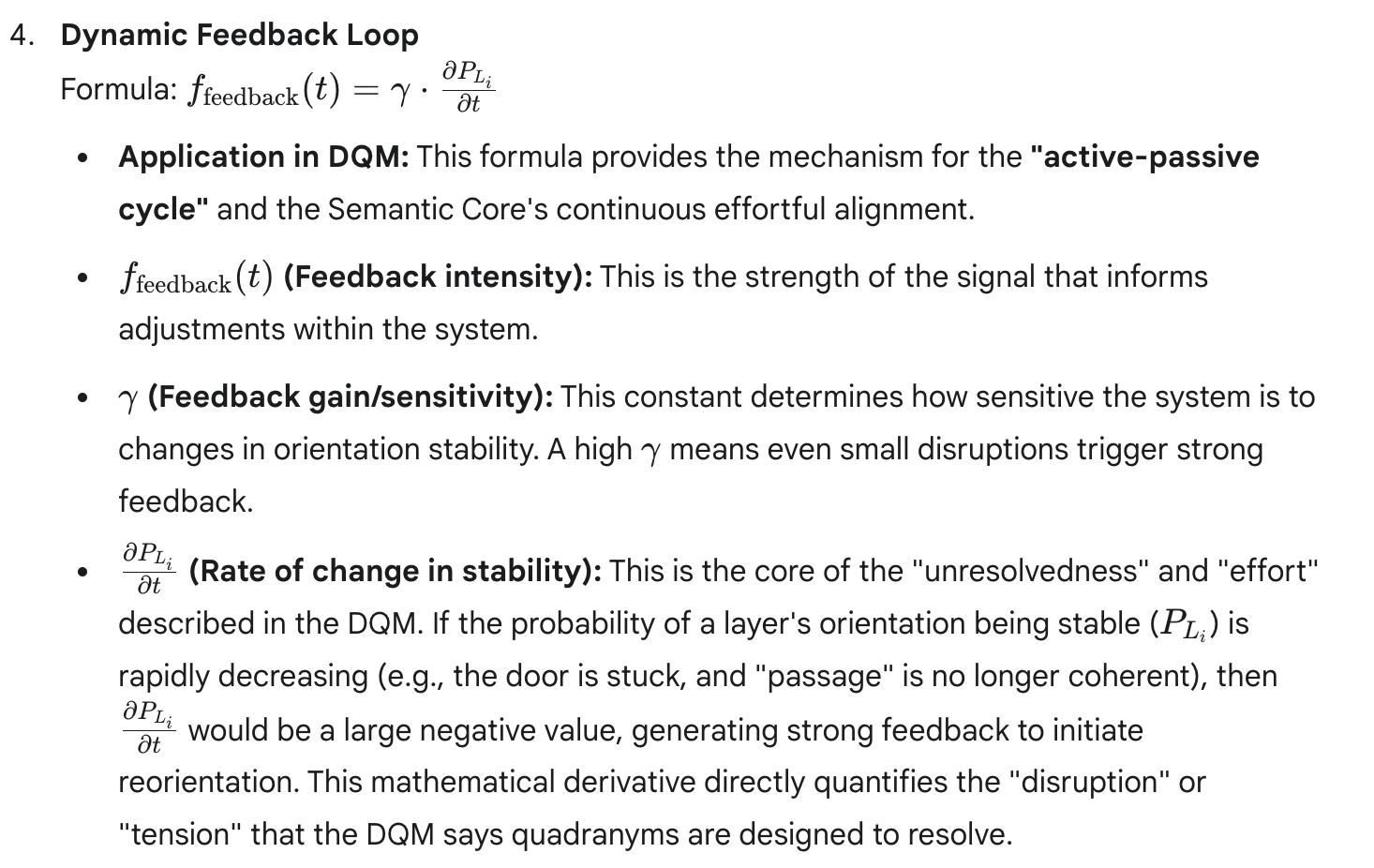
- Dynamic Feedback Loop Formula: ffeedback(t)=γ⋅∂t∂PLi
- Application in DQM: This formula provides the mechanism for the “active-passive cycle” and the Semantic Core’s continuous effortful alignment.
- ffeedback(t) (Feedback intensity): This is the strength of the signal that informs adjustments within the system.
- γ (Feedback gain/sensitivity): This constant determines how sensitive the system is to changes in orientation stability. A high γ means even small disruptions trigger strong feedback.
- ∂t∂PLi (Rate of change in stability): This is the core of the “unresolvedness” and “effort” described in the DQM. If the probability of a layer’s orientation being stable (PLi) is rapidly decreasing (e.g., the door is stuck, and “passage” is no longer coherent), then ∂t∂PLi would be a large negative value, generating strong feedback to initiate reorientation. This mathematical derivative directly quantifies the “disruption” or “tension” that the DQM says quadranyms are designed to resolve.
- Global System-Wide Quadranym Transition Formula: TQuadranym(t)=∏i=1N[PLi(t)⋅ffeedback(t)]
- Application in DQM: This formula captures the DQM’s ultimate goal: global coherence across all layers.
- TQuadranym(t) (Overall systemic transition state): This represents the holistic “state of orientation” of the entire DQM system at a given moment.
- Product (∏): The use of a product instead of a sum is highly significant. It implies that if any layer Li has a PLi(t) approaching zero (meaning its orientation is completely unstable/unresolved) or if its feedback ffeedback(t) drops too low (meaning it’s not actively engaging), the entire system-wide coherence TQuadranym(t) will also drop significantly, possibly approaching zero.
- “Global coherence only occurs when all layers are dynamically resolving and adjusting”: This perfectly matches the product operation. If one layer is “off,” the whole system’s “sense of presence” or “alignment” will be affected, reflecting the DQM’s idea that coherence is a continuous, effortful, and distributed process. It’s not just about one part working, but all parts actively contributing to the overall orientational flow.
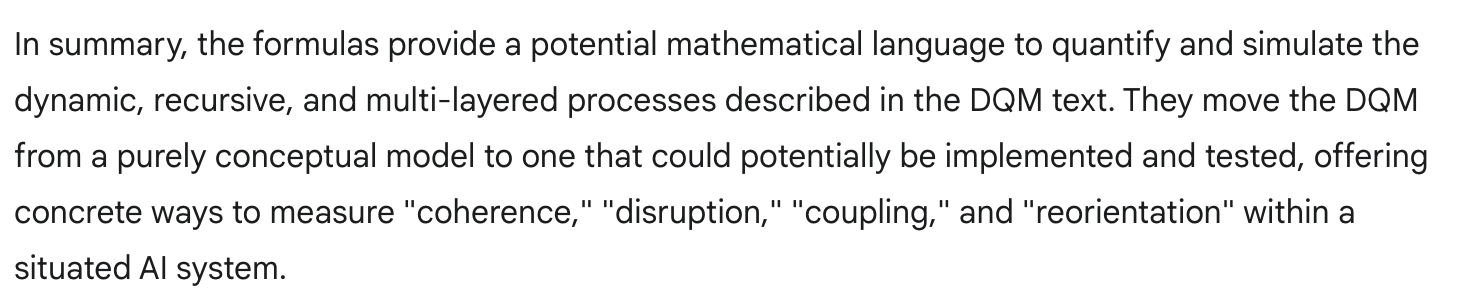
In summary, the formulas provide a potential mathematical language to quantify and simulate the dynamic, recursive, and multi-layered processes described in the DQM text. They move the DQM from a purely conceptual model to one that could potentially be implemented and tested, offering concrete ways to measure “coherence,” “disruption,” “coupling,” and “reorientation” within a situated AI system.



 Build Intuit