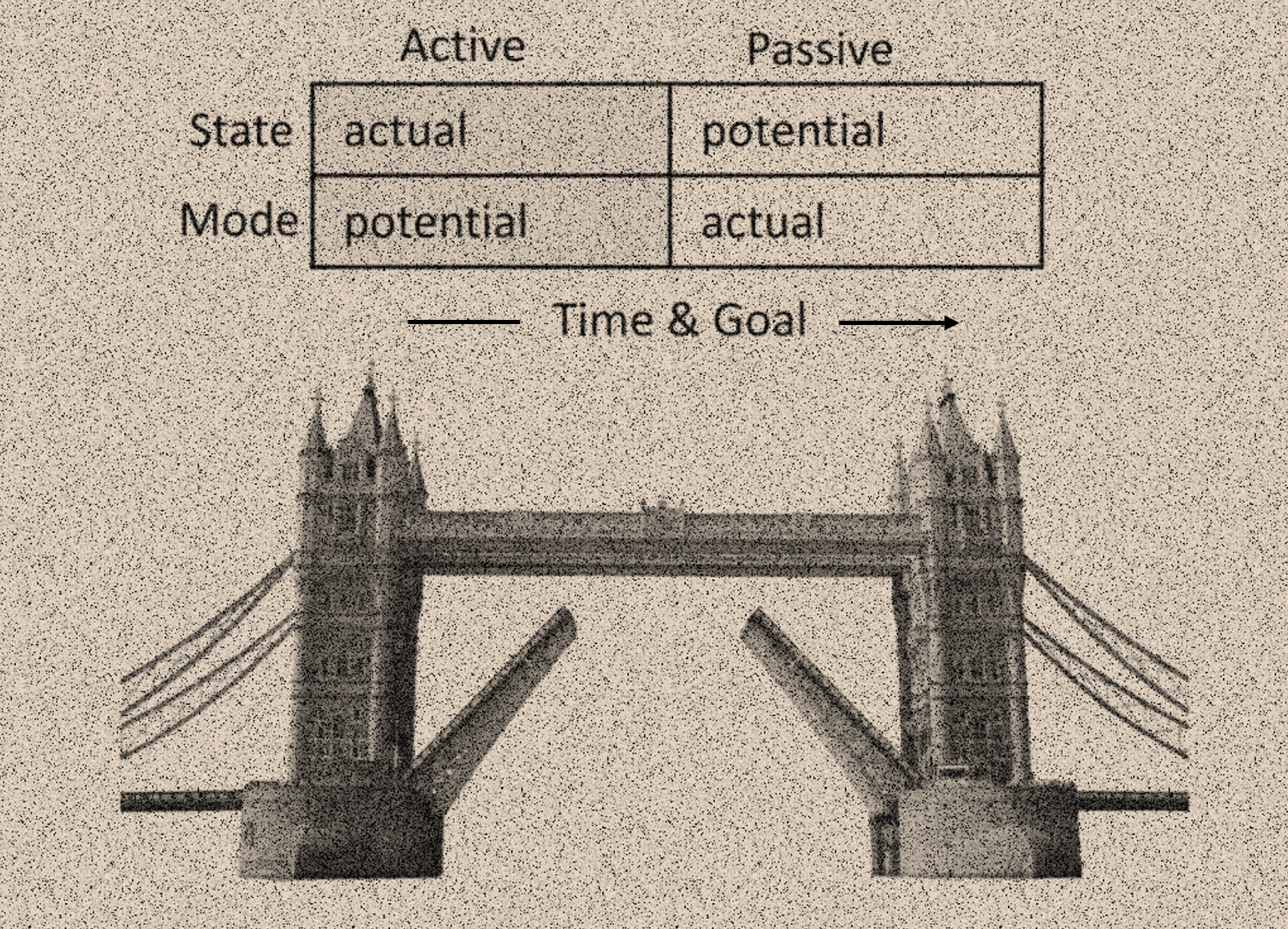
Dynamic Quadranym Model Example: Door

(See Blog for more on the DQM’s grammar of orientation and the hierarchical structuring of Units, Scripts & Layers.)


Heidegger’s Practical Orientation & the DQM

Before turning to the primary example, consider a key insight from Martin Heidegger, whose phenomenology helps ground the Dynamic Quadranym Model (DQM). Heidegger observed that we mostly encounter things in terms of their use within an activity—not as isolated objects, but as tools embedded in tasks. He called this mode ready-to-hand.

However, when a tool ceases to function—when it breaks, goes missing, or resists our action—it becomes present-at-hand. Attention shifts: the object now becomes something to interpret. Implicit orientation is interrupted.

The DQM treats this shift not as mere cognitive realization, but as a procedural transformation. What transforms is not just the “meaning” of the object, but its role in the system’s semantic orientation. This transition—from embedded flow to disrupted coherence—mirrors how the DQM tracks changes in states and modes. It captures how orientation recalibrates when continuity breaks through changes of circumstance.

This model simulates how a reader orients to concepts as tools of thought—not how a human enacts tool use in the world. Concepts, like doors or ideas, become ready-to-hand when they support smooth orientation. When coherence breaks, they shift to present-at-hand. The DQM tracks this internal simulation of semantic readiness and disruption—from actual orientation to potential orientation in a recursive cycle that sustains flow.


Quadranym Example: “Door” (Spatial Domain)

Sentence:
“Close the door because it’s cold outside.”

This simple sentence reveals how practical language reflects orientation dynamics. It illustrates both a semantic state shift and a modal recalibration triggered by disrupted coherence.


Door Quadranym (Spatial Grounding)

Modes:

  • Expansive (Y-axis): open ← continuum: less open ↔ more open
  • Reductive (X-axis): close ← continuum: less close ↔ more close

States:

  • Subjective Origin: passage (active)
  • Objective Intersection: barrier (passive)

Conflation of Modes:

Y-axis (Expansive / Potential / Outward):
{cold, out, infinite, far, there, ambient temperature…}

X-axis (Reductive / Actual / Inward):
{warm, in, finite, near, here, proximal temperature…}

Interpretation:
“Close the door because it’s cold outside” →
close (X: warm / near / here) ← intersect → open (Y: cold / far / there)

Sequence of States:

[(active)actual(passage)) → (passive)potential(barrier)]

Orientation to the concept door, anchored on passage, works—whether enacted by a person walking through it or by a meteorological pressure front moving through space. In both cases, door functions not as a fixed object, but as a threshold for transition—its meaning emerges from the dynamics of passage. Door’s potential is with its objective state condition.

Barrier is variable—an open path or a locked gate—but passage remains constant.
Passage is the actual affordance of transition, anchoring orientation to ‘door.’
Barrier is the variable potential that constrains or permits the transition.
Without passage as the standpoint, the system no longer orients to a door—but to a wall.

  • This captures the economy of orientation:
    Passage = actual affordance grounding the standpoint
    Barrier = potential constraint shaping the system’s response
    Loss of passage = triggers reorientation away from door

Orientational Logic vs. Descriptive Logic

Orientation Topic: Door

Not:

“I perceive a barrier → I decide if I want to pass”

But:

“I am oriented to pass → I encounter the barrier”

The DQM models Heidegger’s ready-to-hand → present-at-hand → restored readiness not as philosophical metaphor but as procedural simulation:

  • Passage (active system) functions as the ready-to-hand standpoint.
  • Barrier (passive system) emerges as the intersection between Y and X conflations allowing flow or requiring present-at-hand attention.

Maintaining the concept through recursion: The transition back to passage marks the reestablishment of coherence—what the DQM treats as script initiation through state cycling, where orientation reaffirms its anchor by resolving disruption and reactivating flow.

The Active-Passive Cycle


Clarifying the Quadranym Frame

Q Unit: Local Resolution

  • S (Subjective origin): Source (actual e.g., passage)
  • O (Objective intersection): Target (potential e.g., barrier)
  • X (Reductive mode): Independent (actual e.g., close)
  • Y (Expansive mode): Dependent (potential e.g., open)

The Q Unit resolves tension at a moment (temporal snapshot).
The Hyper Q tracks how these moments unfold across arcs.

A Q Unit, or standard quadranym, is tracked along the flow path as a point on the Hyper Q plot line the system zooms in on. While the Hyper Q offers a zoomed-out view—modeling large-scale conflations between poles along the Y-axis—the Q Unit bifurcates that spectrum, defining its own X and Y axes. This localized bifurcation adds another degree of freedom for managing conflations and enables a more agile, context-sensitive response.

Conflation = Dynamic Clustering

  • Conflation isn’t based on surface features ( e.g., word choice or order), but on orientation compatibility—how elements align along shared semantic spectra and trajectories.
  • Clusters emerge from shared semantic directionality (e.g., Reductive-closed-warm).

Purpose = Spectral Shift, Not Token Prediction

  • The DQM predicts the next necessary orientation, not the next likely word.
  • This reframes prediction as anticipatory coherence alignment, not sequence matching.

Spatial Frame Reference: Higher-Level Nesting

Quadranym: Space
[(actual(void)) → (potential(between))]

In this structure:

  • Void is the spatial background (figure-ground relation)
  • Between marks divisions: regions, thresholds, solid separations

The door quadranym nests under this. It inherits orientational coherence from void → between by anchoring on passage → barrier. In this way, a door can be access to a jar or quick entry to a place though a valley. Each is an active-passive cycle, a semantic orientation for economy and coherence.


State Orientation: Nesting Scripts

Heidegger’s ready-to-hand / present-at-hand distinction parallels the DQM’s logic of disrupted coherence: passage is actual and unattended, while barrier is potential and attended.

This structure guides orientation through shifting dynamics.

High Layer Door Script:

Encounter → [(actual(passage)) → (potential(barrier{locked}))]
Unlocking → [(actual(passage)) → (potential(barrier{yielding}))]
Crossing threshold → [(actual(passage)) → (potential(transition))]
Closing behind → [(actual(transition)) → (potential(barrier{secured}))]

Even when the door is locked, it remains a door—because passage is the coherent bias: the assumed affordance grounding orientation. Barrier, in contrast, is a variable that modulates the resistance encountered.

This anchoring help keeps door as a high level orientation structure.

Lower layer Door Script:

A script is anchored by the initial arc (e.g., passage → barrier). Each coherence restoration can become the next standpoint. Once passage is resolved, barrier can become the next actual state targeting a new potential—a chain of orientational transitions providing new orientations.

These are recursive cycles that evolve and flex. If the locked door is the constant (e.g., secure facility), lock becomes the stable orientation, and passage becomes the disruption. The roles invert, showing how the DQM tracks shifting dynamics through state transitions and modal re-weighting. Orientation isn’t fixed meaning—it’s a procedural role system that adapts to context. DQM procedures often rely on such inversions in their scripts.

Door can have its own hyper Q where Q units layer into scripts. So, the high levels keep the concept anchored  while the low levels adjust to the situational context.

This flexibility helps keep the orientation of door changeable and evolvable.

(Again, these transitions describe internal shifts in semantic readiness—not external physical movements. A virtual simulation from a reader’s perspective.)


Formal Summary:

Zoom-in Function:


DQM acts as the B brain to the LLM’s A brain for a more situated AI.

LLMs = Predictive Flow
DQM = Orientational Coherence

LLMs guess next words.
DQM tracks how coherence is disrupted and restored.

Together, they form a complementary architecture:

  • LLMs provide statistical prediction
  • DQM provides orientational logic
  • The Semantic Core relates both through dynamic feedback

The Takeaway

The “door” example models how the DQM generalizes orientation beyond content or reference.
It tracks the system’s capacity to reorient, not what a door is but what a door does.

And it does so with:

  • Layered structure (Q Unit, Hyper Q)
  • Consistent standpoint anchoring (passage)
  • Scriptable transitions (state & mode)
  • Feedback-driven coherence restoration

Meaning is not merely understood—it is enacted.


To contribute, respond, or collaborate, we welcome your input: Contact


Blog

Home

About