
From the 1920s until his death in 1974, Bennett (1897-1974) sought to develop a conceptual method— what he called systematics—to clarify the pattern and order of wholes by drawing upon the qualitative significance of number. From a phenomenological perspective, one can argue that Bennett’s achievement is a phenomenology of wholes in which each integer—1, 2, 3, 4, and so forth up to 12—points toward a different mode of togetherness and belonging in regard to the thing being studied, which, in Alexander’s case, is largely order and wholeness. In this presentation I draw on Bennett’s understanding of three, threeness, and what Bennett calls the triad to give clues to the remarkable conceptual and applied power of Alexander’s work. Most broadly, my tack in the presentation is to use one approach to wholeness— Bennett’s—to understand better another approach to wholeness—Alexander’s [1].
The First Eight Systems
(1) Monad = Wholeness
(2) Dyad = Complementarity
(3) Triad = Action & relatedness
(4) Tetrad = Activity
(5) Pentad = Potential
(6) Hexad = Event
(7) Heptad = Transformation
(8) Octad = Completedness
Above From: David Seamon
Department of Architecture Kansas State University Manhattan, KS 66506 triad@ksu.edu http://www.arch.ksu.edu/seamon
The Q model’s eight defining terms in relation to Bennet’s first eight systems.
The Q Ontological Axiom of Agency:
- A State is an actual being. An actual being has a becoming; it is always a potential becoming.
- A Mode is potential action. A potential action has a difference; it is always an actual difference.

- State: the length of a temporal cycle i.e. actual_begin → potential_end
- Mode: a realm of spatial factors i.e. potential_out → actual_in
- Active: refers to more experience necessary i.e. active_ power
- Passive: refers to no more experience necessary i.e. passive_ power
- Temporal Center: being-in-time i.e. active-actual state_subjective
- Spatial Factors: acting-in-space i.e. active-potential mode_expansive
- Apt Events: temporal-becoming i.e. passive-potential state_objective
- Location Relation: spatial-measure i.e. passive-actual mode_reductive
How The First Eight Systems might relate to the Q:
We will refer to this exercise as, eight ways sensibility proves itself.
1. Wholeness = State
One relates to a cycle in time. A Cycle proves the sense of wholeness.
2. Complimentary = Mode
Two relates to spatial factors. A sense of self proves alterity.
3. Action & relatedness = Active Power (more experience necessary)
Three relates to processing power. Seeking proves a sense of Relationship.
4. Activity = Passive Power (no more experience necessary)
Four relates to power identified. The sense of power available.
5. Potential = Temporal Center (active-actual subjective state)
Five relates to being in time. The sense of nowness proves transition.
6. Event = Spatial Factors
Six relates to spatial activity. The sense of activity that proves events.
7. Transformation = Apt Events
Seven relates to temporal becomings. The sense of events that proves change.
8. Completedness = Location Relation
Eight relates to spatial measure. The sense of resolution that proves belonging.
Triads refer to scripts:
- Being
- Becoming
- Resolve
Resolve may take any number of cycles to reach its completedness. Being and becoming create one unit or one cycle. Resolve may end the cycle or begin another frame.
- unit
- script
- layer
Senses begin in units. Units become scripts. Scripts become layers.
Sensibility is about our interactions and relationships to things and the responses that are generated. Consider that there are things we like and don’t like – drawn to or repelled by – make us anxious or relaxed. Sensibility is a term often used to denote these kinds of responses. We suggest, that our responses are repurposed where their dynamics become part of our communicative nature, dynamics that inform our word-sensibility orientations and processes. This repurposing of our responsive dynamics is a essentially a way to play with our experiences. One way we do this is by holding our responsiveness to the different ways we are constrained to play. Each a way to contain a complete system of play.
To help illustrate this Q perspective of play. Consider the pattern and order of wholes as described by J.G. Bennett (1897-1974). By drawing upon the qualitative significance of number (Ed. 1993), Bennett illustrates a method in which the underlying patterns of things are sensed. That is, through a sense of numberness, a oneness, twoness, threeness and so on. Each sense of numberness is a discrete way to contain the dynamics of thought. Each demonstrates a general way to predict how our thoughts will respond. We suggest, that in this way, we can organize our thoughts by holding our sense of responsiveness to different numberness systems and play.
|
The twelve systems are not scientific models but insights into degrees of organisation. In his first major essay in this field, The Dramatic Universe (Vol.
|
Next, consider the Eight Terms of the Q Ontological Axiom of Agency.
- State: the length of a temporal cycle i.e. active_begin → passive_end
- Mode: a realm of spatial factors i.e. active_out → passive_in
- Active: refers to more experience necessary i.e. active_ power
- Passive: refers to no more experience necessary i.e. passive_power
- Subjective: being-in-time i.e. active-actual state_temporal center
- Expansive: acting-in-space i.e. active-potential mode_spatial factors
- Objective: temporal-becoming i.e. passive-potential state_Apt Events
- Reductive: spatial-measure i.e. passive-actual mode_location relation
1. Wholeness (J.G. Bennett) = Q State:
Oneness relates to a full cycle in time. A sense of cycle proves wholeness. STATE
2. Complimentary (J.G. Bennett) = Q Mode:
Twoness relates to spatial difference. A sense of alterity proves the complement. MODE
3. Action & relatedness (J.G. Bennett) = Q Active Power:
Threeness relates to processing power. A sense of action proves relatedness. ACTIVE
4. Activity (J.G. Bennett) = Q Passive Power:
Fourness relates to the powers of a being. A sense of order proves activity. PASSIVE
5. Potential (J.G. Bennett) = Q Temporal Center:
Fiveness relates to being in time. A sense of limit proves potential. SUBJECTIVE
6. Event (J.G. Bennett) = Q Spatial Factors:
Sixness relates to spatial identity. A sense of freedom proves the laws of events. EXPANSIVE
7. Transformation (J.G. Bennett) = Q Apt Events:
Sevenness relates to temporal becomings. The sense of developing proves transformation. OBJECTIVE
8. Completedness (J.G. Bennett) = Q Location Relation:
Eightness relates to spatial measure. The sense of location proves completedness. REDUCTIVE

- 00 = active-actual (–)
- 01 = active-potential (-+)
- 10 = passive-actual (+-)
- 11 = passive-potential (++)
-
active is on = 1
-
passive is off = 0
- Subjective: Active relates to power that drives entities.
- Objective: Passive relates to powers entities use.
- Expansive: Active refers to more experience necessary.
- Reductive: Passive refers to no more experience necessary.
A Q-unit deals with a progression toward wholeness that begins in itself toward a greater whole between other units.
1. State: the length of a temporal cycle i.e. active_begin → passive_end.
12. Potential:harmony in space i.e.potential is excepted_expansive_object_general_value.
- Subjective: Active relates to power that drives entities.
- Objective: Passive relates to powers entities use.
- Expansive: Active refers to more experience necessary.
- Reductive: Passive refers to no more experience necessary.
A Q-unit deals with a progression toward wholeness that begins in itself toward a greater whole between other units.
1. State: the length of a temporal cycle i.e. active_begin → passive_end.
12. Potential: harmony in space I.e.potential is excepted_expansive_object_general_value.
|
The twelve systems are not scientific models but insights into degrees of organisation. In his first major essay in this field, The Dramatic Universe (Vol.
|
Here’s a brief but helpful look at orientation as represented in the Q model.
- In theory, imagining situations require engaging various orienting functions.
Think of imagining as finding orientation with other mental orientations. Situations become individuated based on the orientation functions used.
- In theory, orienting functions are analogs used for situational understanding.
- Orienting functions are in one’s mind and are used to orient with other minds.
(Note: Orienting functions refer to embodied analogs used as a way to learn by comparing abstract symbols to sensory modalities, which can create analogies.)
In the Q model, quadranyms represent orienting functions or analogs. Quadranym units form RF units, scripts or layers for virtual orientation.
- Q units represent embodied analogs such as, agent, energy, time & space.
Each unit represents a unique sensory experience captured in a semantic framework that pivots on self identification opportunity and affordances.
- Embodied analogs require potential states to emerge from actual states.
In the Q, the actual state is the primary, definitive aspect of the embodied analog, while the potential state exists as a kind of capacity and possibility.
- Q units represent the agent’s recall in terms of actual and potential states.
(Note: Quadranyms aim to capture the structure of some event in the world by representing the actual and potential states of the agent’s sensory experience.)
All orienting functions represented by quadranyms follow basic templates:
Prime Superordinate (Template): Potential(actual) ➝ Actual(potential)
(Note: Potential–Actual modes modify actual–potential states. The actual state receives Potential attributes, and the potential state receives Actual attributes.)
Prime Subordinates (Templates Representing Embodied Analogs):
- Agent: Positive(self) ⊇ Negative(goal)
- Energy: Active(motion) ⊇ Passive(matter)
- Time: Future(present) ⊇ Past(event)
- Space: Infinite(void) ⊇ Finite(between)
Above quadranym examples from section a) Quadranym Theory
(Note: Attributes refer to additional information beyond the basic properties of a condition state. Potential attributes are always a response to Actual attributes.)
General analogs such as space, time and energy are routinely used and shared
- Primary orientations are about analogs common between embodied agents.
(Note: In the model, the quadranym is a representation of dynamic sense found between semantic word relations derived from perception and action processes.)
Reference frame models for AI orientation use the template below:
RF Model Template: Topic = Y(source) ⊇ X(target)
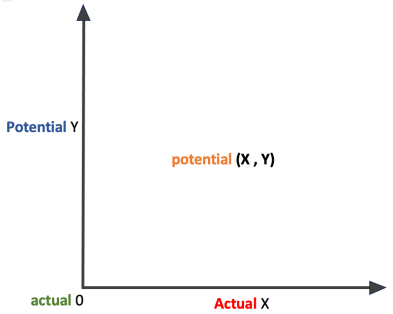
Quadranyms provide faceted categorization for RF models.
- The Y responds to X is based on the situation and the source–target.
- The ontological presupposition will anchor for the relevant potentials.
(Note: When constructing orientation the source and target have different roles to play — a source is the actual condition and a target is the potential condition.)
Inferences are conclusions and orientations are from where they evolve.
- One is oriented, in some manner, to how tendencies evolve in the world.
(Note: source–target relates to affordance: what the world offers the agent; source and target evolvement predicates on what the X factor offers the Y).
See examples in the full article: Orientation
 Build Intuit