

Introduction:
The Dynamic Quadranym Model (DQM) provides a semantic framework for analyzing situational and orientational dynamics. It captures transitions through Hyper Q layers and resolves contextual arcs within Q Units. Bifurcation and conflation serve as core mechanisms, adjusting expansive (potential) and reductive (actual) measures to guide meaning-making and response. This layered approach integrates neutral points, index reels, and semantic alignment to balance context-driven adjustments and internal goals, enabling the model to navigate dynamic inputs effectively.
Subject of orientation analysis:
Drive Story
The clock struck five, and I gathered my things, feeling the weight of the day lift as I stepped out of the office. The usual traffic buzzed around me, but I wasn’t in a hurry. It was a ritual—leaving work and heading toward the tunnel that always seemed to separate the world of deadlines from the calm of home. The air in the car felt different as I drove toward it, like the promise of peace was just ahead. I entered the tunnel, the world narrowing around me as the hum of the engine and the quiet of the road swallowed the noise of the day. The headlights reflected off the wet walls, and for those brief moments, I was insulated from everything that had come before. Exiting the tunnel, I felt that familiar wave of relief. The city behind me, the chaos left in its wake, and all that lay ahead was my street—quiet, familiar, and mine. As I pulled into the driveway, the weight on my chest lifted completely. I was home.
Scaffold Matrix: Story Analysis
| Layer | Quadranym (Orientation) | Context (Situation) | Text Variants | Latent Variants |
|---|---|---|---|---|
| General | Space: [Infinite(void) → Finite(between)] | The office to the tunnel to home. | “The tunnel that separates the world of deadlines.” | Space narrows and provides a dividing line. |
| Relevant | Direction: [There(position) → Here(relation)] | Moving from work (there) to home (here). | “Exiting the tunnel… ahead was my street.” | Transition from distant to proximal. |
| Immediate | Emotion: [Joy(feeling) → Sorrow(reaction)] | The relief felt upon arriving home. | “The weight on my chest lifted completely.” | Relief and calmness emerge after tension dissipates. |
| Dynamic | Energy: [Active(motion) → Passive(matter)] | Driving through the tunnel and relaxing. | “The world narrowing… insulated from everything.” | The car moves actively; the person relaxes passively. |
Breakdown by Layer
General Layer
- Quadranym: Space: [Infinite(void) → Finite(between)]
- The narrative establishes a broad, overarching spatial context, starting from the infinite bustle of the city and narrowing to the finite peace of home.
- Key Context: The tunnel represents the boundary or transitional “between” space.
Relevant Layer
- Quadranym: Direction: [There(position) → Here(relation)]
- Tracks the directional movement from work (“there”) to home (“here”).
- Key Context: The tunnel serves as a bridge between the distant workplace and the immediate, relational space of home.
Immediate Layer
- Quadranym: Emotion: [Joy(feeling) → Sorrow(reaction)]
- Captures the emotional arc, moving from the weight of the workday to the relief of returning home.
- Key Context: The transition from tension (sorrow-like reaction) to relief (joyful feeling).
Dynamic Layer
- Quadranym: Energy: [Active(motion) → Passive(matter)]
- Describes the active driving motion transitioning to the passive relaxation of being home.
- Key Context: The tunnel journey involves the active engine hum and culminates in the passive sense of relief upon arrival.
Key Observations
- Arcs of Orientation:
- Each layer tracks a distinct arc of resolution, with the General Layer establishing the broad spatial journey, while the Immediate and Dynamic layers resolve emotional and energetic tensions.
- All arcs culminate in the shared endpoint of “home,” where the narrative finds closure.
- Conflation Across Layers:
- Space (General) and Direction (Relevant) conflate to highlight the tunnel as both a spatial divider and a directional bridge.
- Emotion (Immediate) and Energy (Dynamic) conflate to express how motion (active) transitions into a state of emotional relief (passive).
- Layer Interdependence:
- The General and Relevant layers provide structural scaffolding for the Immediate and Dynamic layers, which deliver the narrative’s emotional and experiential depth.
This scaffold matrix allows us to dissect the story’s layered dynamics systematically and explore how orientation (quadranyms) and situation (context) interact.
List of basic Components
1. Hyper Q (Contextual Flow Path)
- Definition: Represents the progression of orientations through time, organizing layers of contextual alignment.
- Key Features:
- Y-Axis: Smooth continuum of expansive-reductive potential across orientational layers (e.g., General → Relevant → Immediate).
- X-Axis: Unidirectional flow of time, marking sequential progression through arcs.
- Purpose: Guides the system’s macro-level understanding of context.
- Supporting Roles:
- Neutral Points: Anchors on the Y-axis that provide calibration for bifurcation in modes.
- Arcs: Represent temporal progression, closing when states align with contextual inputs.
2. Q Unit (Instance of Time)
- Definition: A snapshot of orientation at a specific instance in the Hyper Q.
- Key Features:
- Y-Axis: Bifurcated expansive-reductive polarities, providing independent adaptability.
- X-Axis: Context-specific procedural reasoning or dynamics (e.g., [Y → X] transitions).
- Purpose: Resolves semantic tensions and adapts dynamically at a granular level.
- Supporting Roles:
- Arc Closure: Resolves arcs within a bounded instance of time.
- Bifurcation: Ensures modes dynamically adjust to input changes via independent polarities.
3. States (Nested Orientation)
- Definition: Represent the subjective (actual) and objective (potential) orientations within arcs.
- Key Features:
- Subjective State: Current, grounded orientation (e.g., self → sight).
- Objective State: Anticipated or target orientation (e.g., other → object).
- Purpose: Provide semantic structure for contextual reasoning.
- Supporting Roles:
- Latent Variants: Single words that refine states to match context.
- Example: Adding “dim” to clarify the subjective state of sight.
- Arc Satisfaction: States resolve when subjective-objective alignment occurs.
- Latent Variants: Single words that refine states to match context.
4. Modes (Dynamic Measures)
- Definition: Polarized expansive (potential) and reductive (actual) measures that guide adaptation.
- Key Features:
- Expansive Mode (Y): Tracks potentiality (e.g., Light, Vision).
- Reductive Mode (X): Tracks actuality (e.g., Darkness, Blind).
- Purpose: Measure and adapt to dynamic changes within the context.
- Supporting Roles:
- Reels: Dynamic measures of expansive-reductive polarities.
- Example: Expansive Light {6}, Reductive Darkness {4}.
- Bifurcation: Recalibrates expansive and reductive reels independently in response to context.
- Example: If Light decreases, reels adjust Darkness upward while calibrating Vision.
- Reels: Dynamic measures of expansive-reductive polarities.
5. Conflation
- Definition: Blends semantic dimensions to align with contextual input while preserving distinction where necessary.
- Key Features:
- Purpose: Reduces cognitive load by merging overlapping facets (e.g., Light ↔ Vision ↔ Sight).
- Supporting Roles:
- Latent Variants: Clarify conflated states (e.g., specifying “dim” for Light).
- Neutral Points: Facilitate reel adjustments during bifurcation.
6. Neutral Points
- Definition: Calibration anchors on the Hyper Q Y-axis, enabling dynamic bifurcation.
- Key Features:
- Purpose: Align expansive-reductive polarities across modes, ensuring contextual coherence.
- Supporting Roles:
- Reel Calibration: Aligns expansive and reductive measures to the neutral point.
- Example: Vision as the neutral point between Light and Darkness.
- Arc Resolution: Guides bifurcation to close arcs with semantic balance.
- Reel Calibration: Aligns expansive and reductive measures to the neutral point.
7. Arc Closure Feedback
- Definition: Evaluates how well states align and how modes adapt during arc resolution.
- Key Features:
- State Feedback: Ensures subjective-objective alignment for arc satisfaction.
- Mode Feedback: Validates reel adjustments during bifurcation to maintain coherence.
- Purpose: Provides self-correcting mechanisms for orientation and progression.
8. Three-Reel Structure (Facet and Connecting Reels)
Definition: The Three-Reel Structure models the dynamic interplay between two independent facet reels (Expansive and Reductive) and a non-linear connecting reel that mediates between them. It allows for nuanced, real-time adaptation to contextual shifts while maintaining semantic coherence.
Key Features:
- Facet Reels (Independent, Linear):
- Expansive (Y-axis): Represents potential or possibility (e.g., light, future, potential outcomes).
- Reductive (X-axis): Represents actuality or reality (e.g., darkness, present, achieved outcomes).
These two facet reels operate independently within their respective domains, progressing linearly but without direct interdependence.
- Connecting Reel (Non-Linear):
- Mediates between the expansive and reductive facets, allowing their independent movements to interact dynamically. The connecting reel doesn’t mirror a 1:1 ratio of opposites but allows the system to respond flexibly and adaptively to context.
Purpose:
- Guides the system’s micro-level response to real-time context by enabling independent yet coherent shifts in the expansive and reductive facets.
- Ensures semantic coherence across shifts, maintaining flexibility while preserving meaning.
Supporting Roles:
- Neutral Points: Anchors that help calibrate the relationship between expansive and reductive movements within the connecting reel. Neutral points provide reference points for adjustments in the system.
- Arcs: Represent movement between potential and actuality, with the connecting reel facilitating the smooth integration of these shifts. Arcs close when the system reconciles its orientations and transitions from one state to the next.
- Dynamic Feedback: The three reels, working in tandem, allow for ongoing adjustments as context shifts, with feedback loops ensuring that changes in one reel impact and inform the others dynamically.
Summary of Moving Parts
| Component | Role | Supporting Features | Purpose |
|---|---|---|---|
| Hyper Q | Flow path of time | Neutral Points, Arcs | Guides macro-level contextual alignment. |
| Q Unit | Instance of time | Bifurcation, Arc Closure | Resolves granular tensions dynamically. |
| States | Nested orientation | Subjective/Objective, Latent Variants | Provide semantic structure for arcs. |
| Modes | Dynamic measures | Reels, Neutral Points, Bifurcation | Adapt expansive-reductive polarities. |
| Conflation | Semantic blending | Latent Variants, Neutral Points | Align overlapping facets to the context. |
| Neutral Points | Calibration anchors | Reel Calibration, Arc Resolution | Maintain semantic coherence. |
| Arc Feedback | Evaluates resolution | State and Mode Feedback | Ensures progression and adaptability. |
The DQM framework emphasizes:
- Hyper Q and Q Units: Hyper Q tracks temporal progression; Q Units handle contextual moments.
- Bifurcation and Conflation: These calibrate expansive-reductive dynamics (modes) and refine subjective-objective states.
- Neutral Points and Reels: Provide calibration points for dynamic adjustments, aligning measures to situational inputs.
- Arc Closure: Resolves states and modes, advancing the system along temporal and semantic axes.
The framework ensures adaptable, context-sensitive processing, linking situational cues to orientational goals for coherent decision-making and meaning resolution.
Visualization Charts
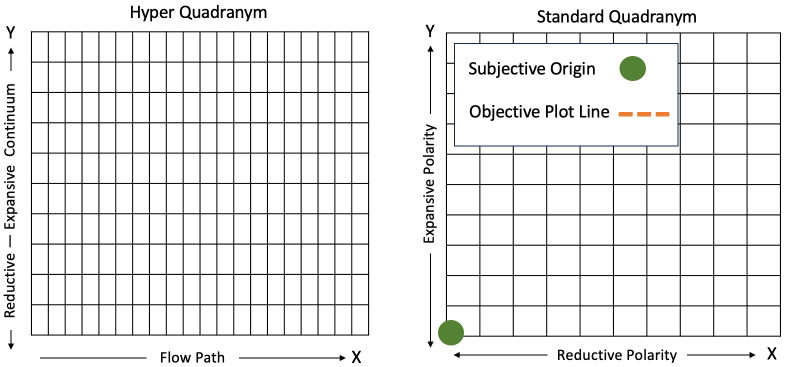
Y axis on the left splits into independent X-Y continuums on the right .
Dynamic Adaptability: Quadranym Duel Continuum
Going through a tunnel eyes dynamically adjust to the amount of light. The DQM captures that dynamic.
Single Continuum:
- Represents a linear scale between two extremes.
Example: Light ↔ Dark - Limitations: While effective for basic analysis, this continuum doesn’t capture the nuances between potential (what could be) and actuality (what is). Both extremes are treated as a singular, undifferentiated scale.
Dual Continuum (Bifurcation):
- The continuum of Light ↔ Dark is split into two independent axes:
- Y-axis (Expansive Potential): Light can conflate with vision and possibility.
- X-axis (Reductive Actuality): Dark can conflate with lack of sight and limits.
- These axes move independently allowing each distinct continuum to adjust to context e.g., light can reduce due to glare and dark can reduce due to a flashlight.
Feedback Dynamics:
- The dual continuum structure enables context-sensitive interplay:
- Reducing darkness (X-axis) enhances light’s potential (Y-axis).
- This bidirectional feedback loop adapts dynamically, ensuring balanced orientation.
When you switch on the light, darkness no longer serves as the absence of light; it transforms into something more dynamic and integral to the scene. It defines boundaries, contrasts, and depth—highlighting areas that remain in shadow, creating texture, and influencing how we perceive the space. In essence, darkness becomes an active player in shaping how light is experienced and interpreted. This isn’t just a binary of light vs. dark; it’s a cooperative dynamic where one shapes and gives meaning to the other.
A Deeper Look:
-
Contrast: The light can now define the shape, color, and texture of objects, but it’s the darkness that makes the contrast possible. Without shadow, there’s no definition of form; the light itself would lose its meaning. The interplay between light and dark gives us a sense of depth and perspective.
-
Shade and Positioning: Darkness helps us position things in space. What remains in shadow tells us where things are relative to the light source, influencing how we interpret distance and orientation. In a sense, darkness becomes a tool of orientation, giving spatial coherence to the illuminated scene.
Example in Real Life:
Think about a stage performance:
-
When the lights come on, the stage comes into focus. But the darkness, instead of simply being the absence of light, plays an active role in shaping the scene. The shadows under the characters’ feet, the dark corners of the stage, and the spotlighted areas all work together to define the positions of objects and actors, creating a narrative structure.
-
The light might reveal a face or an object, but it’s the darkness that defines its contours, highlights its features, and places it in context. Without this interplay, the visual scene would feel flat or incomplete.
The Nonlinear Role of Darkness:
This is where the nonlinear relationship really shines. Darkness isn’t just a passive absence, but an active definer of meaning in relation to light. The shift from light ↔ dark isn’t linear because darkness doesn’t just “fill in” what light doesn’t show; it dynamically interacts with light to create contrast, shape perception, and form boundaries.
- Feedback Loop: As light increases, the darkness responds by retreating, but it doesn’t just disappear—it becomes part of the new structure. If the light dims, the darkness grows, but this growing darkness isn’t just a mirror image; it’s now actively shaping the space in new ways, reorienting our perception.
In the Dual Continuum model, expansive potential (light) and reductive actuality (dark) don’t just oppose each other—they transform and define each other. Each axis moves dynamically, giving us a much richer, more interactive view of the world.
To Summarize:
In this framework, light and dark work together in a nonlinear, co-creative relationship. Light defines what’s visible and expansive, while dark gives structure, contrast, and depth. They don’t just counterbalance each other—they interact dynamically, creating a rich, complex environment where each shift in one axis directly influences the other. This interplay allows us to perceive the world not just as a simple spectrum, but as a multidimensional, adaptive system—where potential and actuality are constantly reshaping and redefining each other in real time.
Final Thoughts:
By introducing bifurcation—splitting a single continuum into dual axes of expansive potential and reductive actuality—we gain a new level of flexibility and responsiveness. This dynamic system can adapt in real-time, shifting meaning fluidly as contexts evolve, without losing sight of its overarching goals or themes.
At its core, the DQM doesn’t just capture a snapshot of meaning—it tracks shifts in real-time, calibrating our understanding according to context while preserving coherence and purpose. The interplay between neutral points, reels, and bifurcated axes creates a structure that allows for rich, layered semantics—ideal for AI-driven systems, real-time decision-making, and adaptive reasoning.
As we move toward more context-sensitive technologies, the potential for real-time adaptive semantics is enormous. Whether applied to AI, digital assistants, or even narrative structures, the DQM promises to enhance our ability to understand and navigate complex situations, providing a new layer of semantic flexibility that is both responsive and anchored in long-term objectives.
In an age where meaning is increasingly contextual, the DQM offers a path forward, inviting us to rethink how we approach understanding, interpretation, and decision-making.
 Build Intuit