

The idea is that orientations respond to situations. Let’s demonstrate with our favorite scenario, the missing keys. The orientation to the scenario is hierarchically structured from general to relevant orientations:
- Space: Keys are real objects.
- Time: Searching is a procedure.
- Energy: Effort and determination.
- Agent: Keys are needed.
With the orientation structure sketched out, we can begin imagining our scenario (the potential situation). This is where quadranyms come in. Here is a preview of what quadranyms can look like.
Each layer represents a quadranym balancing states and modes:
- Space:
- Subjective (Actual State): “I am searching the living room.”
- Objective (Potential State): “The keys might be under the couch.”
- Modes: Expansive (possibilities), Reductive (locations).
- Time:
- Subjective (Actual State): “I’m still searching.”
- Objective (Potential State): “It’s taking too long.”
- Modes: Expansive (determined), Reductive (frustration).
- Energy:
- Subjective (Actual State): Determination to continue.
- Objective (Potential State): Clutter as friction to progress.
- Modes: Expansive (effort), Reductive (drain).
- Agent:
- Subjective (Actual State): “I need the keys.”
- Objective (Potential State): “I will search the entire house.”
- Modes: Expansive (exploration), Reductive (resolve).
Each quadranym layer is an iterative script enhanced by feedback.
Modes and States: Modes measure the dynamics of how orientation progresses between states. In the Time example, determination (expansive mode) reflects sustaining effort, while frustration (reductive mode) reflects increasing constraints. Together, these modes form the equation that defines the transition from the subjective (current focus: “I’m still searching”) to the objective (anticipated resolution: “It’s taking too long”). So, by providing the potential-to-actual resolution, modes form the equation that defines the transition from the actual state to the potential state. This mathematical foundation enables the system to calculate transitions and maintain coherence in orientation while dynamically guiding responses across layers—general, relevant, and immediate.
The idea might seem strange at first, but once the distinction between modes as measures and states as situationally driven transitions clicks, it becomes intuitive; the model links modular sequences together, with each module providing a complete arc of orientation, functioning as a grammar.
Quadranyms form to Situational contexts and repurpose for new orientations.
Basic Annotation and Quadranym Example
Quadranym: Space
The Space Quadranym is an elegant entry point into the model, highlighting the interplay between modes (dynamic measures) and states (semantic orientations). Each aspect is carefully annotated to ensure clarity and coherence within the system.
States and Modes
- States:
- Fixed semantic positions represented in parentheses individually (e.g.,
(void)or(between)). - In transitions, states are enclosed in brackets to represent the relationship as a unit (e.g.,
[void → between]). - Fully annotated states may include conflation or contextual modifiers (e.g.,
(actual(subjective(void)))), in nested parentheses capturing their nested semantic orientation. - States are lowercase. Use parentheses when single or nested in a unit, unless just two terms are used to represent a unit, as shown.
- Fixed semantic positions represented in parentheses individually (e.g.,
- Modes:
- Measure dynamic transitions between states, appearing outside parentheses (e.g.,
Infinite(void)orFinite(between)). - Multiple modes are separated by hyphens (-) without spaces (e.g.,
Potential-Expansive-Infinite(void)), reflecting simultaneous measures (i.e., each word is some degree of an index or reel). - Modes are capitalized without brackets (e.g.,
Infinite → Finite) - Brackets only used for modes when represented within a state unit.
- Measure dynamic transitions between states, appearing outside parentheses (e.g.,
Together, states and modes form a fractal structure, repeated dynamically across layers to capture the interplay between fixed semantic stability and transition.
Space Quadranym Example
- Representation:
[Infinite(void) → Finite(between)] - Description:
- Infinite(void): Is the undefined spatial potential (e.g., an open area).
- Finite(between): Is the spatial specificity (e.g., narrowing the area).
- Spatial Orientation Grammar Distinction:
- Modes:
Infinite → Finite - States:
[void → between]
- Modes:
- General Orientation Grammar Distinction:
- Modes:
Potential → Actual - States:
[actual → potential]
- Modes:
Example Transition
- From:
Infinite(void)(e.g., Possibility(find)) - To:
Finite(between)(e.g., Location(keys))
Resolution and Sequence
- Modes (Measure Resolution):
Potential-Infinite → Actual-Finite - States (Semantic Sequence):
[(actual(lost)) → (potential(find))]
latent variants (e.g., actual) couple with the text variants (e.g., lost).
Example Latent Variants
States:
- From:
(void):{unobstructed, empty, missing, blank} - To:
(between):{objects, regions, solid, abstract separation}
Modes:
Latent variants can clarify contextual adjustments to dynamic measures:
Expansive {Signal} → Reductive {Received}:From open possibilities (signal) to actual resolution (received).Potential {Unseen} → Actual {Observed}:Indicates a process where potential is realized through contextual alignment.
Feedback: Orientation Cycle
- Script Representation:
[(actual(find)) → (potential(keys))] → [(actual(keys)) → (potential(found))]
- Script Description:
A resolute task upon completion becomes a satisfied potential, setting the foundation for future expectations of the actual state and orienting to new situations that align procedurally through structured steps and dynamically through adaptive responses (i.e., anticipation potential).
- State Units and Scripts:
State units are enclosed in brackets([a → b]). These units can be combined into scripts, and transitions between units are represented using two sets of brackets([b] → [a]), linking the second state of the first unit to the first state of the second unit i.e., two units linked together. In this example, potential keys become actual keys, providing new potentials for the orientation. Recursive transitions ensure that each actualized state grounds the system for new potentials.
- Transition Quadranym:
[(potential(keys))] → [(actual(keys))]- To be clear: these quadranyms are shorthand for how prior units link to the next:
([b] → [a]). Notice how[b](prior unit) in brackets links to[a]in brackets (next unit), each implies a unit of paired states([a → b])i.e., a normal unit representation where both state variables are explicitly shown in a single set of inward facing brackets. Every unit has an actual state (a) and a potential state (b).
- To be clear: these quadranyms are shorthand for how prior units link to the next:
- Feedback serves as the heart of the DQM, providing iterative adjustments to maintain coherence, while the Dynamic Cycle reflects the blood flow—showing how state orientations evolve directionally from actual to potential, maintaining alignment between actualized and potential orientations. Orientation grammar depends on this syntax, ensuring quadranyms remain flexible and responsive across layers. Feedback iteratively aligns the general, relevant, and immediate layers, ensuring that transitions stay both coherent and adaptive.
Time-lines cycle at different lengths on different layers as a system. For example, over arching goal such as “need keys” is shorter and repetitive while “check under shoes and bags” is longer with more procedural detail.
- Procedural and Dynamic Alignment:
Anticipation draws from history to establish the foundation for future expectations, while adaptation engages the immediate context to align dynamically with new situations. Procedural alignment follows a structured sequence, such as retracing where the keys were last seen, whereas dynamic alignment adjusts in real-time, responding to unexpected obstacles like realizing the keys might be in a jacket pocket.
Active-Passive Cycle
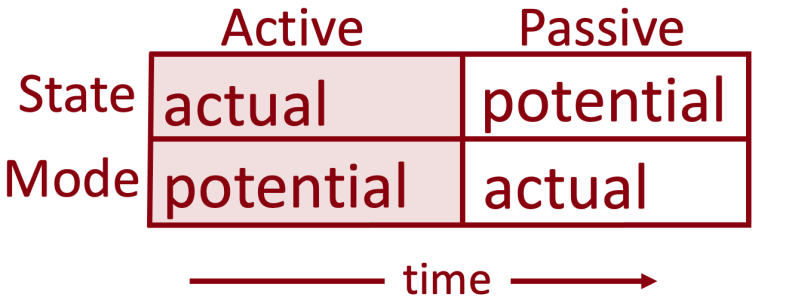
An active-passive cycle represents how an orientation transitions from engagement to resolution, completing a meaningful arc. The active phase initiates an action or intent, while the passive phase concludes the arc, making the moment tangible and salient for the agent. This isn’t about objects being active or passive but about how orientations achieve closure.
The cycle provides the experiences and expectations that guide future actions. These expectations, represented by the passive-potential state, reflect what the agent anticipates based on prior resolutions.
Example: Stepping Out of Bed:
- Active = Step → Passive = Floor
- The act of stepping transitions into the realization of the floor’s stability. This passive phase anchors the moment, allowing the agent to move on to the next orientation.
- The floor itself isn’t passive; it’s the orientation—stepping to stand—that resolves into the passive phase.
The difference between what we actively create and what we passively receive.
Core Arc Logic and Pairing Rule
This is the central engine of the grammar, describing a continuous, cyclical process. It dictates how an orientation transitions from one state to the next.
- Initiation: An Active Orientation occurs when a State actual (the fixed starting point) is combined with a Mode potential (the dynamic, expansive measure). This pairing represents the beginning of an action or an arc.
- Transition: The Modes themselves are what measure the transition from a State actual to a State potential.
- Resolution: A Passive Orientation is the combination of a State potential (the target position) with a Mode actual (the reductive measure of completion). This passive resolution marks the closure of an arc and creates the new condition for the next actual state to begin.
Takeaway:
The passive phase completes the arc of orientation, ensuring the moment is experienced fully and recognized as significant. It also sets the foundation for future expectations, providing a passive-potential state that anticipates similar stability in subsequent actions.
Clarification: Orientation Grammar
Orientation grammar tracks the progression of orientation through the condition of states (actual or potential) and the responsiveness of modes. At any point of a procedure a state will be either actual or potential. In the Space quadranym: [Infinite(void) → Finite(between)], the actual state (void) may seem like a potential state but NOT according to this spatial orientation—where the potential state is (between) NOT (void). Actual states initiate as constants and do not require change and this is the reason why spatial orientation is (void). The potential and change is (between) as objects and multiple spaces come to define the potentials of space. Infinite and Finite measure those possibilities by Spatial Orientation anchoring on actual (void) that can then target the potential (between). This does not mean that a subject, object or verb of a text is categorized as being (void) in the actual state of this spatial quadranym e.g., (void(unobstructed(“seeker”))) allows the “seeker” to be in the actual state of space while the potential of (between) can target the particular space of the context. This becomes an iterative sequence within the given context where the actual state conforms to the potential states as it cycles through.
Scaffold Matrix
Quadranym relations are visualized in various Scaffold Matrices (SM).
Prime Quadranym (Local Unit Configuration)
- Representation:
[Expansive(subjective) → Reductive(objective)] - Explanation: Each dimension represents variables, e.g.,
[Y(a) → X(b)]- Y-X: Measurable Semantic Variables
- a-b: Sequential Semantic Variables
Empty Quadranym Template:
- [Y(a) → X(b)]
- a: Source orientation
- b: Target orientation
Spectrums (Axes):
- Y-axis (Potential): Less ↔︎ More (e.g., abstract, possibilities, remoteness)
- X-axis (Actual): Less ↔︎ More (e.g., concrete, immediacy, proximity)
Summary Table for Quadranym Facets
| Facet | Description | Example | Transition |
|---|---|---|---|
| Expansive (E) | Focuses on possibilities, exploration, and potential. | Searching multiple rooms for keys (Where might they be?). | Expansive ➔ Reductive: Narrowing down options. |
| Reductive (R) | Narrows focus to specific actions, outcomes, or realizations. | Checking the kitchen counter for keys (Are they here?). | Expansive ➔ Reductive: Re-evaluating options if unsuccessful. |
| Subjective (S) | Captures internal, personal, emotional or constant aspects of the context. | Feeling urgency or frustration during the search (I need to find them now!). | Subjective ➔ Objective: Aligning emotions with external tasks. |
| Objective (O) | Represents external, situational, or factual aspects of the context. | Physical location of the keys on the counter (The keys are here). | Subjective ➔ Objective: Reflecting satisfaction upon success. |
Principles
Components, Logic, and Application
1. The Structure of a Quadranym
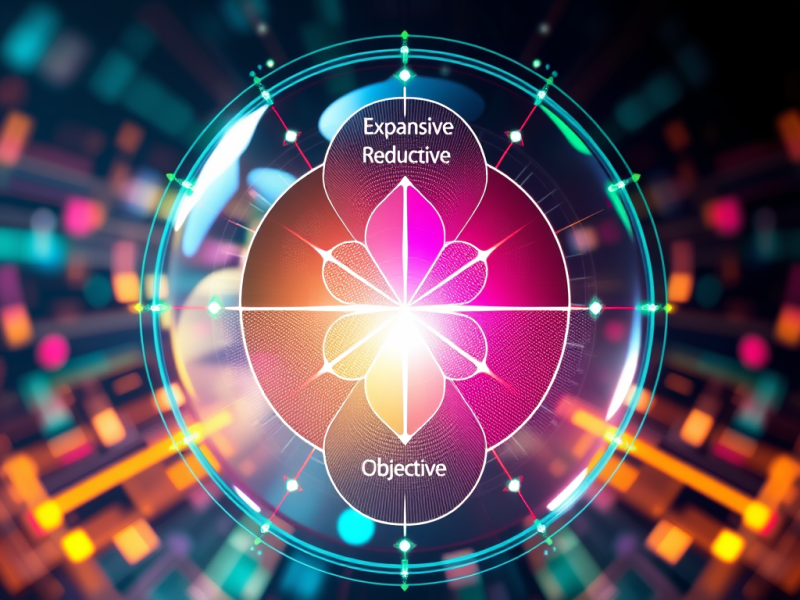
A quadranym is composed of four interrelated facets:
- Expansive (E): Focuses on possibilities, exploration, and potential.
- Reductive (R): Narrows focus to specific outcomes or realizations.
- Subjective (S): Captures the internal, personal, or emotional aspect of the context, or any term acting as the constant of the local orientation.
- Objective (O): Represents the external, situational, or factual aspect of the context, or any term acting as the variable of the local orientation.
These facets are dynamic poles that interact, creating a responsive structure capable of adapting orientation to changing meanings.
2. Why Four Dimensions?
The quadranym reflects a universal semantic grammar, rooted in how humans intuitively orient themselves to meaning. Its four-faceted structure is designed for:
- Comprehensive Coverage: The quadranym captures all essential elements of orientation:
- What’s possible (E) versus what’s specific (R).
- What’s personal (S) versus what’s situational (O).
- Spatiotemporal Representation:
- Modes (E → R) reflect spatial measures.
- States ([S → O]) reflect temporal progression.
- Dynamic Interplay: Expansive exploration (E) often begins with subjective curiosity (S), transitioning into objective specifics (O) through reductive focus (R).
- Practical Modularity: The quadranym’s simplicity allows it to be stacked, nested, or sequenced for more complex reasoning processes.
3. Quadranym Logic and Grammar
Unlike standard syntactic grammar, orientation grammar emphasizes process and orientation over fixed rules or outcomes.
Basic Grammar Rules:
- States: Transition from [actual → potential], anchoring orientation at subjective points while moving toward unresolved objectives or expectations.
- The actual state initiates orientation and sets the foundation to actualize potential in the next actual state cycle.
- The potential state represents the unresolved target driving progression, creating satisfied and/or unsatisfied arcs.
- Modes: Measure progression between states, balancing:
- Expansive: Broadens focus (e.g., opening possibilities).
- Reductive: Narrows focus (e.g., resolving outcomes).
The state sequence must always flow as [actual → potential]. Orientation initiates in the actual state to anchor the process and ensure coherent progression toward the potential. Modes track the resolution.
4. Mapping Quadranym Dynamics with the Q Grid
The quadranym (Q) grid maps modes only across two axes, offering flexibility in tracking orientation dynamics:
- Standard Configuration:
- Y-Axis: Mode (Expansive).
- X-Axis: Mode (Reductive).
- Example:
- The keys (Expansive_Potential) could be in the living room (Reductive_Actual).
- The seeker (subjective Sarah) occupies the purely semantic origin (0.0), while the potential possessor is represented as a coordinate point (n, n).
- Mode Continuums:
- Bifurcated between the X (Reductive) and Y (Expansive) polarities, providing semantic and context-free spectral dynamics for orientation.
5. Mapping States and Modes with the Hyper Q Grid
The Hyper Q grid maps quadranyms dynamically across two axes, offering flexibility in tracking orientation:
Standard Configuration:
- Y-Axis: Modes (Expansive ↔ Reductive) as a vertical continuum.
- X-Axis: States ([actual → potential]) as progression along the flow path.
- Example: Sarah’s determination to push forward (expansive) contrasts with frustration caused by clutter (reductive), measured as orientation progresses.
Inverted Configuration:
- Y-Axis: States ([actual ↔ potential]) as a vertical continuum.
- X-Axis: Modes (Expansive → Reductive) tracking flow paths horizontally.
- Example: Sarah shifts states dynamically (actual: “Searching here” → potential: “Keys might be elsewhere”), with expansive effort measured horizontally against reductive focus.
Inverted Hyper Q ensures coherence as orientation progresses:
- Vertical Movement: Adjusts semantic focus between subjective (internal) and objective (external) states or modes.
- Horizontal Movement: Measures flow paths as transitions evolve dynamically through states or modes, depending on the axis configuration.
6. Folding and Unfolding Continuums
Continuums in the Hyper Q represent open semantic polarities that evolve dynamically before being folded into actionable meaning through bifurcation.
Unfolded Continuum:
As touched on in 5…
- Y-Axis: Polarities such as subjective-objective or reductive-expansive remain open, enabling flexible semantic orientation.
- X-Axis: Tracks procedural flow (e.g., Potential → Actual or [actual → potential]), allowing exploration of temporal and structural alignments.
- Relationships coexist without premature resolution, accommodating both exploration (e.g., “Where might the keys be?”) and reflection (e.g., “The keys were here yesterday”).
Bifurcation:
As touched on in 4…
- At neutral points, the continuum splits into distinct meaning pathways:
- Example: [subjective → objective] for states or Expansive → Reductive for modes.
- Neutral points act as stabilizing anchors, ensuring transitions remain coherent while reflecting context-specific demands.
This folding mechanism transforms broad semantic possibilities into actionable states, dynamically adapting meaning to meet situational needs while maintaining coherence.
At balanced points, expansive and reductive dynamics create neutral associations that bridge their polarities:
| Continuum | Expansive (Y axis) | Reductive (X axis) |
|---|---|---|
| Level 1 (neutral point) | Focus | Broad |
| Level 2 | Topic | Narrow |
| Level 3 | Scope | Detailed |
| Level 4 | Range | Specific |
| Level 5 | Universe | Precise |
7. Quadranyms and Nested Systems
Quadranyms adapt to complexity by nesting within broader structures, enabling multi-layered orientation:
- Scripts: Sequential quadranyms tracking state and mode progression over time or procedure.
- Example: Moving from living room → hallway → bathroom creates a procedural script for the seekers search.
- Layers: Hierarchical quadranyms organize orientation at different levels:
- Outer Layers: Stabilize broad orientations (e.g., “Keys are needed”).
- Inner Layers: Address situational specifics (e.g., “Check under the couch”).
Scripts and Layers ensure quadranyms scale effectively across general, relevant, immediate, and dynamic layers.
8. Layers of Orientation
The Dynamic Quadranym Model (DQM) operates across four key layers:
- General Layer: Stabilizes high-level orientations (e.g., “Keys are objects”).
- Relevant Layer: Aligns orientation to specific contexts (e.g., “Searching the living room”).
- Immediate Layer: Adapts to real-time decisions (e.g., “Check under the couch”).
- Dynamic Layer: Responds to feedback, adjusting all layers dynamically as the situation evolves.
Each layer builds on the others, enabling orientation to remain adaptable yet grounded, balancing expansive exploration with reductive focus.
9. Nested Quadranyms: Scripts and Layers
Quadranyms can scale dynamically by nesting into broader structures, enabling orientation to respond to complexity:
- Scripts: Represent sequential quadranyms that guide procedural flow.
- Example: Sarah’s search follows a sequence:
- Living Room → expansive possibilities.
- Hallway → transitional focus.
- Bathroom → reductive resolution.
- Example: Sarah’s search follows a sequence:
- Layers: Organize quadranyms hierarchically across layers:
- Outer Layers: Stabilize broad orientations (e.g., “Keys are needed”).
- Inner Layers: Address situational specifics (e.g., “Keys might be under the couch”).
Scripts and layers ensure quadranyms operate flexibly across scales of meaning, maintaining coherence as orientation progresses.
10. Orientation as Process
The DQM redefines orientation as an evolving process rather than a fixed purpose. This ensures meaning remains adaptable and responsive across dynamic contexts:
- Actual-Potential Flow: Meaning unfolds recursively, where actualized states generate new potentials, keeping orientation dynamic.
- Example: Finding the keys (actual) leads to where they might be needed next (potential).
- Recursive Meaning Generation: Resolved points become stepping stones for future explorations, avoiding overfitting and maintaining semantic flexibility.
- Purpose from Process: Goals emerge naturally from the orientation process, aligning with context rather than forcing pre-determined resolutions.
In Q theory, the potential state remains unresolved for the orientation, which focuses on process. However, the situation requires progression and resolution at opportune cycles.
By emphasizing process over fixed outcomes, the DQM mirrors how cognition adapts naturally to changing contexts.
The DynamicaL Context
- What is the difference between a dynamic and a dynamical context?
In theory, a dynamic context refers to the changes occurring within a situation, effectively communicating the public changes belonging to the situational context. In contrast, a dynamical context pertains to self-regulating systems within a multi-organizational dynamic framework, relaying responsive contexts across private layers. Put simply, the dynamic context addresses external, observable changes in a situation, while the dynamical context manages internal, layered responses to those changes.
 Build Intuit