

Imagine sitting on your couch, remote control in hand. You press a button to change the channel, adjust the volume, or browse streaming options. The remote, a simple and familiar tool, embodies an intricate interplay of meaning and action. It is proximal—immediate and tangible—while the TV it controls is remote, a distant target activated by your command. This ordinary interaction is an excellent entry point into the world of the Dynamic Quadranym Model (DQM), a framework that captures the dynamic flow between proximity and remoteness, potential and actual, action and resolution.
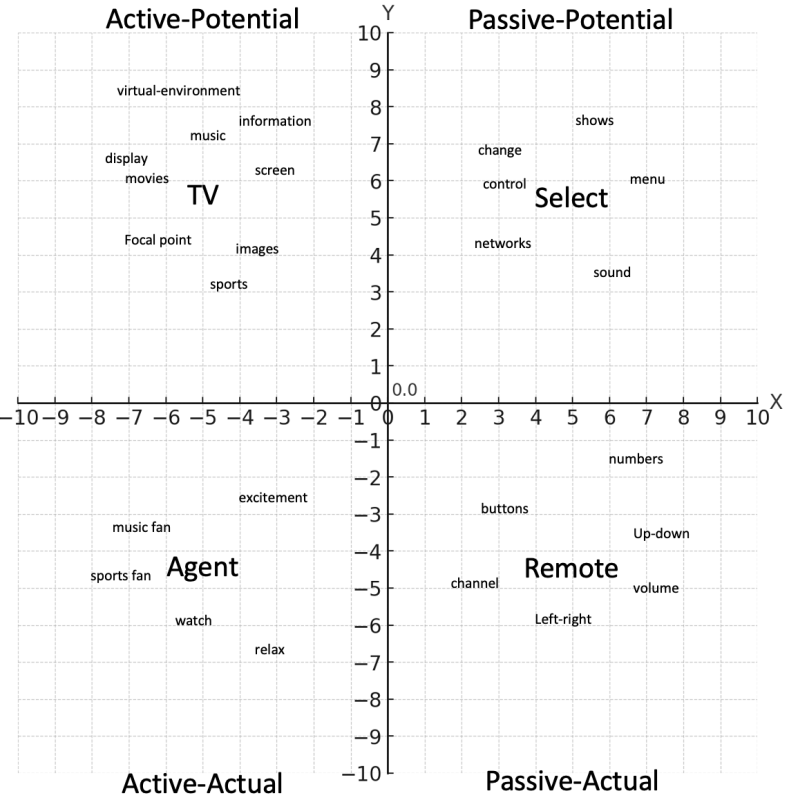
Dynamical Context: TV Remote Facets and Clusters
In this small scenario, the roles are clear: you, the user, are the active-actual agent, driving the interaction with your intent. The remote controller is passive-actual, a tangible tool waiting to be engaged. The control itself—what the remote can do, such as changing the channel—is passive-potential, a latent possibility waiting to be activated. Finally, the TV represents active-potential, embodying a broad range of possibilities—channels, volume levels, settings—that can be explored. By pressing a button, you complete the circuit: expectation (passive-potential) transforms into action (active-actual), resolves into an outcome (passive-actual), and generates a new cycle of intent.

This process, though intuitive, reveals the core mechanics of the DQM: a recursive loop where meaning dynamically shifts and resolves across layers. It’s not just about controlling a TV; it’s about understanding how humans engage with the world, continuously balancing urges and resolutions in context-sensitive interactions. And when these layers of interaction stack—general goals at the top, specific details below—they create a symphony of orientations, each layer contributing to a rhythm of meaning-making.
Layered Orientations: The Beats of Interaction

The beauty of the DQM lies in its layered structure, where each level operates as part of a broader system:
- General Orientations: These provide the steady beat, anchoring meaning with overarching goals. In the remote control example, the general orientation might be “engage with the TV”—a broad purpose that guides the interaction.
- Relevant Orientations: These refine the focus, narrowing the possibilities. For example, “find something to watch” introduces a more specific orientation.
- Immediate Orientations: These capture situational actions, such as “change the channel” or “adjust the volume.”
- Dynamic Adjustments: At the lowest layer, real-time inputs and feedback fine-tune the interaction, like navigating a streaming menu or responding to what’s on screen.
Each layer builds on the one above, much like a musical score where the basic rhythm grounds the melody while variations and improvisations emerge in the details.
Jazz and the Symphony of Urge and Resolve

To fully appreciate the DQM, let’s switch metaphors: think of it as a symphony of orientations, where each layer contributes to a dynamic interplay of urge and resolve. The general cycles set the basic beat, grounding the system in a steady rhythm of intent and action. These cycles might represent broad goals, like “leave the house” or “finish a task.”
But like a jazz ensemble, the DQM thrives on improvisation. The lower cycles, closer to real-time interaction, riff off the general beat, adapting fluidly to the situation. Just as a jazz soloist responds to the chord progression while introducing new elements, the DQM’s dynamic adjustments explore the nuances of context, creating intricate patterns of meaning that resolve and regenerate.
This interplay mirrors the recursive flow of urge and resolve:
- Urge (active-potential & active-actual) represents the system’s readiness to explore possibilities—its expectation of what could happen.
- Resolve (passive-actual & passive-potential) is the satisfaction of that urge, stabilizing meaning in the moment.
- This resolution feeds back into the system, generating new urges, much like a jazz soloist returns to the theme after an improvisation.
In this way, the DQM isn’t just a model for meaning-making; it’s a process of creative interaction, layering rhythms and melodies into a symphony of dynamic understanding.
Proximity, Remoteness, and Spectral Meaning
At the heart of the DQM are spectral orientations—dimensions like Proximal ↔ Remote or Expansive ↔ Reductive. These aren’t static categories; they’re spectral measures, meaning shifts occur continuously along a continuum:
- Moving toward proximity (e.g., selecting a specific channel) inherently reduces remoteness (the abstract range of possibilities).
- Similarly, becoming more reductive (narrowing focus) reduces expansiveness (exploring broadly).
These shifts create moments of balance, where opposing forces zero out. For instance, when the channel you want appears on screen, the expansive search resolves into a reductive outcome. This dynamic flow is the essence of DQM—orientations aren’t fixed but evolve fluidly, adapting to the unfolding context.
Closing the Circuit: A Recursive Loop

The power of the DQM lies in its ability to close the circuit of interaction. The system continuously moves through a loop:
- Passive-Potential (Expectation): The latent possibilities held by the remote control, the TV, or the situation.
- Active-Actual (Engagement): Your action, initiating the process.
- Active-Potential (Exploration): The TV’s dynamic response to the action, opening new possibilities.
- Passive-Actual (Resolution): The concrete result, which resolves the initial urge and sets the stage for the next cycle.
This recursive process operates across layers, generating a rhythm of meaning-making that feels natural and intuitive.
From Remote Controls to Improvised Symphonies
The journey from pressing a button on a remote to imagining the DQM as a jazz-like symphony highlights the model’s versatility. At its core, the DQM is about situating meaning dynamically, balancing broad goals with specific actions, and continuously adapting to context. Like a jazz ensemble, it thrives on the interplay of structure and spontaneity, creating a living, responsive system that mirrors the rhythms of human thought and action.
So next time you pick up your remote, think of it not just as a tool but as part of a symphony—your intent setting the beat, your actions improvising the melody, and the resolution feeding back into the rhythm. In this way, the DQM transforms even the simplest interactions into a dynamic dance of meaning and orientation.
 Build Intuit