

Introduction: Basic Components
1. Contextual Axes
- Meaning evolves along oppositional axes like proximity ↔ remoteness or urgency ↔ calmness.
- These axes enable fluid bifurcation of meaning, adapting to spatial, temporal, emotional, or abstract changes.
2. Bifurcation
- The process of splitting and aligning meaning dynamically along axes, ensuring flexibility and adaptability.
- Example: Sarah’s search bifurcates spatially (near ↔ far) and emotionally (urgency ↔ frustration) as her search progresses.
3. Quadranym Structure
- Quadranyms organize meaning into balanced oppositional dimensions (e.g., expansive ↔ reductive, objective ↔ subjective).
- They act as modular frameworks that ensure coherence across general and relevant layers of meaning.
4. Scripts
- Scripts link orientations into a sequence, providing a timeline for meaning to unfold dynamically.
- Each script adapts to context through feedback, connecting actions, intentions, and outcomes.
- Example: Sarah’s search script evolves from searching close spaces (kitchen) to remote ones (bathroom), aligning spatial and emotional shifts.
5. Feedback Loops
- Orientations are adjusted through feedback between active phases (e.g., searching) and passive outcomes (e.g., finding or not finding).
- Feedback ensures that meaning evolves coherently, integrating outcomes into the next step of the process.
6. Layered Orientation
- General Layers: Anchor broad, overarching dimensions like time, space, and goals.
- Relevant Layers: Adapt these dimensions to specific scenarios, focusing on situational details.
- Dynamic Orientation: Fine-tunes meaning in real-time, based on immediate contextual cues.
7. Context-Free and Context-Sensitive Dynamics
- Meaning is held in a flexible, open-ended state (context-free) but adjusts responsively to specific cues (context-sensitive).
- This dual capacity ensures both generalization and situational adaptability.
Orientation Grammar: Components
Empty Quadranym Template:
- [Y(a) → X(b)]
- a: Source orientation
- b: Target orientation
Spectrums (Axes):
- Y-axis (Potential): Less ↔︎ More (e.g., abstract, possibilities, remoteness)
- X-axis (Actual): Less ↔︎ More (e.g., concrete, immediacy, proximity)
Explanation:
X-Y represent the modes of the states a-b. Specifically, PotentialY-ActualX are measures applied to the states a and b. These measures act as actions that position X-Y variables on the spectrums—establishing word associations based on latent and relevant contexts. To be clear:
- X-Y represent both measures and semantics (i.e., word associations contextualized along their axes).
- a and b represent only semantics (i.e., the source and target orientations in the system of meaning).
The Generic Quadranym:
- Modes Y-X and States a-b:
- [PotentialY(actual = a) → Actual X(potential = b)]
The Fixity of Spatiotemporal Sense
Prime Quadranym Dimensions (Facets):
Modes:
- Expansive = Y (Active-Potential): Wholeness — actively seeking inclusivity or open-ended exploration.
- Reductive = X (Passive-Actual): Separateness — focusing on distinctions or narrowing to actionable specifics.
States:
- Subjective = a (Active-Actual): Individual — a self-identifying or centered state reflecting direct engagement.
- Objective = b (Passive-Potential): Other — external or distributed elements influencing interaction.
Representation:
- Prime Quadranym: [E(s) → R(o)]
Finding the Fixity of Plurality Space
The tension between expansive (E) and reductive (R)
Plurality: [Wholeness (individual) → Separateness (other)]
The R = Wholeness View:
R as the controlling, singular force imposes a static, unyielding structure that stifles growth and adaptability. It essentially freezes the system, prioritizing constraint over expansion. This setup risks locking the system into a fixed state, suppressing innovation, diversity, and change.
The E = Wholeness View:
In contrast, when E is singular and R is multiple, the system can maintain cohesion (through E’s unifying orientation) while still allowing individual contributions and adaptability (through multiple R’s). This promotes a dynamic balance where structure supports growth rather than suppressing it, aligning with a system that’s responsive and evolving over time.
Prime Topic Examples
General Orientation (Layers):
- Space: [Infinite (void) → Finite (between)]
- Time: [Future (present) → Past (event)]
- Agent: [Positive (self) → Negative (goal)]
- Energy: [Active (motion) → Passive (matter)]
Relevant Orientation (e.g., Keys Story):
- Agent-Space (e.g., Sarah): [Remote (position) → Proximity (location)]
Explanation:
General quadranyms set foundational constraints that ground relevant quadranyms. They guide word associations to align with orientation roles—such as spatial, temporal, or agent-based—ensuring coherent, adaptable interpretation across contexts.
Layered Reference Frames
Each layer organizes the sentence’s components into specific source and target orientations, anchoring meaning dynamically. Below shows how each orientation layer parses the text and base verb. Notice in the graph that there is a target orientation (passive set) and the context of text (the focus). The source orientation (active set) anchors how the target orientation (association array potentials) aligns with the context of text.
Orientation Layers for: Let’s move the couch over there.
| Layer | Reference Frame | Source → Target (Orientation) | Target (Context of Text) |
|---|---|---|---|
| 1 | Space | Infinite (void) → Finite (between) | move the couch over there |
| 2 | Time | Future (present) → Past (event) | the couch → move |
| 3 | Distance | There (position) → Here (relation) | move”→ over there |
| 4 | Energy | Active (motion) → Passive (matter) | move → the couch |
| 5 | Agent | Positive (self) → Negative (goal) | let’s → move |
Plot Points
- Subjective (Origin): Positioned at the origin, serving as the foundational starting point.
- Objective (Coordinates): Positioned on the plot line, representing a word target as a coordinate.
Dynamic Mechanics
Active-Passive Cycles:
- Active states (E-S): Engage immediate, dynamic responses.
- Passive states (R-O): Stabilize orientations and hold latent meaning.
- These cycles allow systems to adapt to evolving contexts through rhythmic feedback.
Explanation:
The passive state functions as a buffer, mediating between the agent (the active initiator) and the environment (the broader context or target).
Active-Passive Cycle Example:
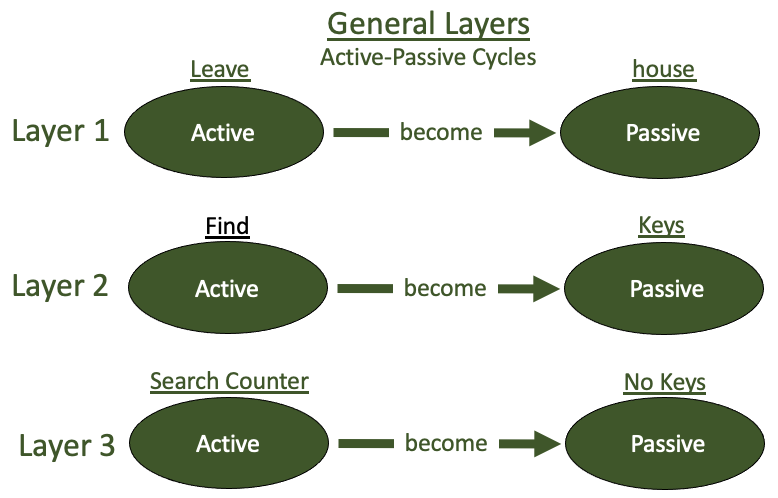
- Active Phase:
- Action: Agent searches the kitchen counter.
- Passive Phase:
- Reflection: Keys are not on the counter.
Cycle Renewal:
- The agent moves to another room, dynamically adjusting strategy based on spatial and emotional cues.
Bifurcation:
- Divides associations along spectral axes (e.g., proximity/remoteness or expansive/reductive).
- Tracks shifts dynamically, creating meaning through change rather than static association.
Scripts:
- H Scripts: Horizontal, where an objective association becomes the next subjective anchor (e.g., a linear progression).
- V Scripts: Vertical, connecting unrelated objectives to subjectives, allowing for flexible, non-linear transitions.
Interaction:
- The cycles capture evolving feedback between agent and environment (or context).
Key Principles
- Separate: Keep meaning/context and measure distinct.
- Prioritize: Define general terms before adding specific terms.
- Strategize: Find different ways to implement the first two principles.
Meaning as a Goal, Not a Given:
- The model doesn’t provide understanding on its own—it targets understanding. Its focus is on the process not the outcome. Meaning is the coupling between the orientation and the situation.
About Orientation Grammer
Prime Quadranym (E, R, O, S):
- DQM dynamically interprets data while following this compact structure, balancing open-ended (E) and focused (R) orientations alongside objective (O) and subjective (S) perspectives.
- This structure is simple yet powerful, grounding the model’s complexity while making it adaptable, modular, and accessible across varied situations.
Challenges:
- Cognitive Shift: Moving from static to fluid grammar requires rethinking how meaning is structured.
- Unfamiliarity: Researchers accustomed to fixed grammar rules might struggle with the non-linear, adaptive mechanics of DQM.
Reader’s Perspective:
DQM places the reader (or agent) at the center, interpreting shifts dynamically. Constraints are provided by the given context of text:
- Meaning evolves as the agent interacts with context, guided by orientation grammar.
- The model’s quadranym framework ensures meaning remains coherent despite fluidity.
Core Principle:
- Adaptability: The model reshapes meaning in real-time, prioritizing the relationship between elements over rigid structures.
- Agent-Centric Design: Meaning emerges from the agent’s orientation (subjective/objective, expansive/reductive) within context.
 Build Intuit